
If you’ve ever dreamed about turning your knowledge into a course or digital product but felt unsure about where to start… trust me, I relate. Before I created my first digital product, I went around and around (and around) in my head for months. I had expertise, skills, ideas by the boatload but what I lacked was clarity.
TL;DR:
Find the sweet spot between one specific transformation you can help someone achieve that plays to your natural strengths and experience
Choose whatever format makes it easiest for your customers to use and implement
Use social listening and AI to validate your topic’s market demand before spending time creating it
When I finally committed, I spent a solid month putting together a 97-page interactive ebook. AI wasn’t a thing back then, so it was just me trying to organize two decades of life lessons into something coherent.
I sold enough copies to justify the time I spent, but I learned something far more valuable than money: I had built what I knew people needed, not what they knew they needed. That distinction was the most important lesson I’ve ever learned (and the next digital product I created made real, consistent revenue).
Whether you work with clients, create content for an audience, or just want to add an additional revenue stream to your business, you know you have valuable knowledge to share. The challenge is figuring out how to package it into something people actually want to buy.
The good news? You don’t need to be a designer, copywriter, or tech expert. There are tons of easy-to-use tools and templates that can do the heavy lifting for you. That part is actually easy and totally figureoutable (I promise).
The part that really matters—the part only you can do—is having a strong, sellable idea and a clear strategy to make it irresistible to buyers.
In this post, I’m going to show you how to identify your most valuable knowledge, choose the right format for your content so it’s easy to sell, and recommend tools that make the creation process simple.
Ready? Let’s dive in. 😎
Step 1: Identify Your Profitable Expertise
The best place to start is to think about what you already know and do best. Many people get stuck here because they aren’t sure if their knowledge is valuable enough to turn it into a product. But the truth is, you likely have multiple areas of expertise that could become successful digital products, you just need to identify them.
Profitable expertise typically shows up in three key ways:
✔️ Solving specific problems
✔️ Developing unique methods or frameworks
✔️ Explaining complex topics in a simple way
Let’s break these down…
Solving Specific Problems
Instead of getting caught up worrying about whether you’re ‘expert enough,’ focus on how you’re already helping people. What are you good at fixing, improving, or making easier?
If you’ve helped even one person solve a problem (yourself included), chances are good there are more people out there actively searching for help with that problem too.
Think about:
- What problems do people come to you for help with?
- Which questions do you get asked over and over?
- When do people say, “I wish I could do that like you do”?
- What processes do you naturally explain to others?
Instead of answering the same question repeatedly, create a digital product that does it for you.
An example from my own product catalogue:
When I was working as a brand designer, I often needed to find Google fonts appropriate for my clients, and it would take forever to scour through Pinterest and the Google Fonts library to find the right ones.
Boom: problem identified.
Surely other designers and business owners struggled with the same problem, so I spent a couple of days creating the “Font Personality Swipe File” and categorized the best Google fonts by brand personalities in a beautifully designed PDF. I sold it for $7 and made thousands.

Developing Unique Methods & Frameworks
People often systematize their work without even realizing it. If you’ve created a template, checklist, or document that makes a process easier for you or your clients, chances are others would find it valuable too.
Ask yourself:
- What processes or systems have you developed that make your work easier or more efficient?
- What templates, checklists, or documents have you already created that could save someone else time?
- Do you have a unique way of organizing tasks, projects, or information that others might find useful?
👉 If you’ve built something that improves your workflow, chances are, others will find it valuable too.
An example from my own digital product catalogue:
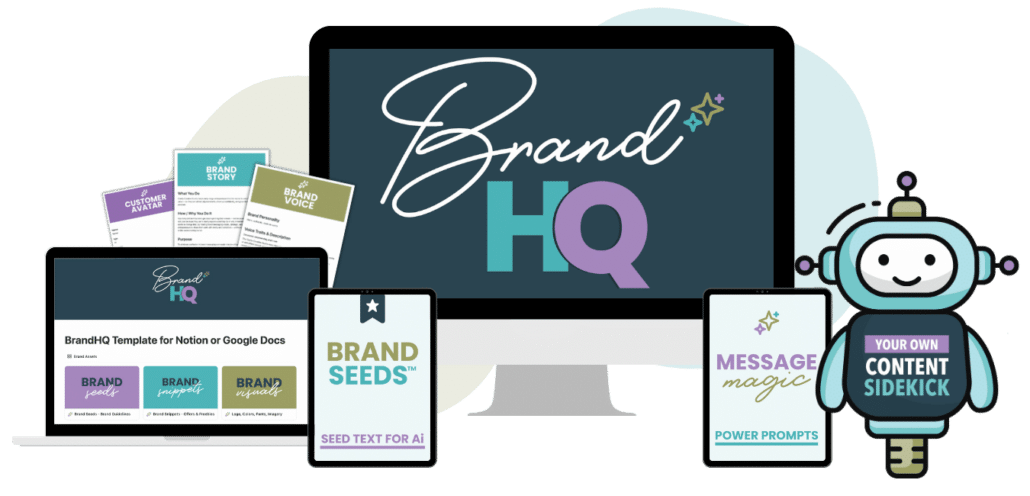
When using AI tools, I got really tired of describing my brand voice, offer descriptions, and content assets just to get AI to help me create a quick social media caption or email. So I set up a system for using AI to create branded “seed text” and a Notion dashboard to organize it. No more repeating myself forever, just copy/paste/go and the content is adapted for my specific business and goals.
That process became a workshop that showed the step-by-step process and my system of tools and my AI assistant. “BrandHQ” is now one of our best selling digital products.
Explaining Complex Topics Simply
If you have a knack for breaking down complicated ideas into easy-to-understand steps, that’s a valuable skill. People are willing to pay for clarity, especially in industries where things feel overwhelming.
Ask yourself:
- What analogies do you use to explain technical concepts?
- How do you break down complex processes into simple steps?
- Which of your explanations make people say “Oh, now I get it!”?
👉 If people regularly say, “Oh, now I get it!” when you explain something, that’s a sign there’s real demand for your knowledge—and an opportunity to turn it into a digital product that helps even more people.
An example from my own digital product catalogue:
I have a background in web coding, SEO, and the technical aspects of blogging going way back, but I often get overwhelmed with the technical jargon one has to sift through in order to just know what the heck is going on and what we’re supposed to do.
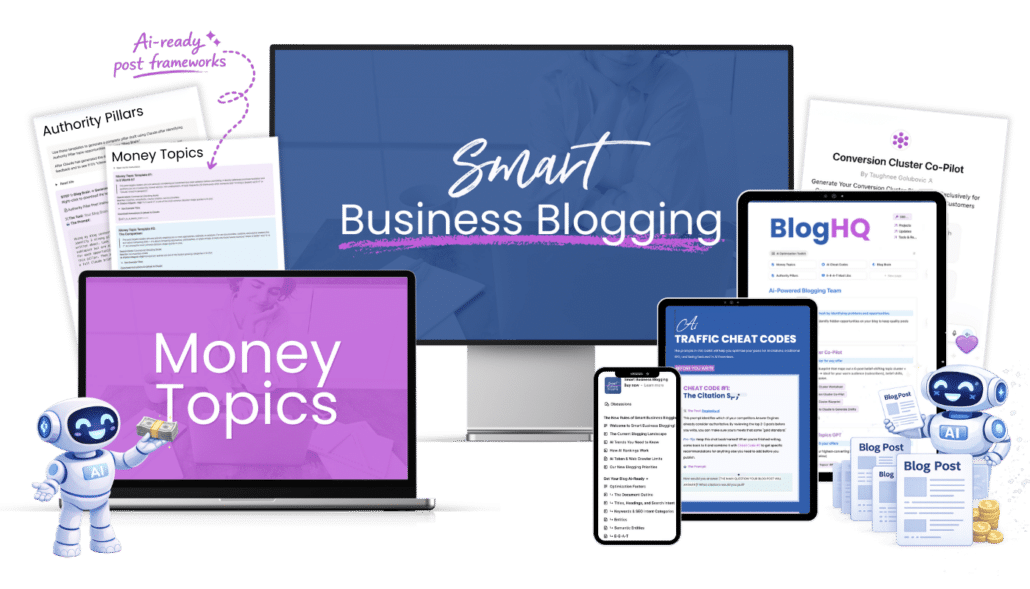
So when I created Smart Business Blogging with the intention of getting business bloggers up to speed, I spent careful attention to translate “nerd speak” so the technical concepts were approachable but more importantly, easy to implement.
This is a skill that AI really can’t replicate. Yes, anyone can get information from AI now, but what they can’t get is a human breaking it down in human terms. The students inside my course could have just asked ChatGPT or Gemini to explain all these things, but when I explain them, it clicks.
Finding Your Product Sweet Spot
Now, take a step back. The best digital products come from the overlap of your expertise, the way you naturally teach or solve problems, and what people are actively looking for help with. This is your sweet spot where your knowledge becomes a product people are eager to buy.
The most successful digital products combine:
➝ A unique approach (your method, system, or framework)
➝ A real demand (a problem people struggle with and want solved)
➝ A clear transformation (guiding them from problem to solution)
Once you identify this intersection, the next step is choosing the best format to package your knowledge into a sellable digital product.
But before you move on, you want to validate that your sweet spot idea is a problem your audience can actually name. Not just a problem you can see they have, but one they’re already searching for help with, talking about in comments, or expressing frustration over in forums and Facebook groups.
I do a lot of this type of research with AI now. Tools like ChatGPT and Claude are surprisingly good at identifying emotional patterns in customer language and surfacing how real people describe a problem, which is different from how experts (a.k.a. you) describe it. I use that alongside old-fashioned listening: reading comments, paying attention to the questions that keep coming up, and noticing the exact words people use.
If you want a structured way to do this and find your sweet-spot idea in about the time it takes to eat your lunch, the Validate Your Digital Product Idea with AI Workshop walks you through the process step-by-step. It’s inside our Digital Product Starter Kit which is a $158 value, but if you use the link below, I created a coupon code (as a special thanks for reading this far! 😉) and you can grab it for $27:
👉 Click here to grab the Digital Product Starter Kit for $27
Step 2: Package It into the Right Format
Your expertise can be packaged in several different ways, and the right format depends on how your audience prefers to learn and what makes it easiest for them to take action.
Let’s break down the most common options:
Workbooks & Templates
Workbooks and templates are designed to give your audience a structured, ready-to-use resource. Instead of just teaching a concept, these products help people implement what they’ve learned.
They work best when your audience needs:
✅ Step-by-step guidance to complete a task or reach a goal
✅ Fill-in-the-blank exercises to apply what they’re learning
✅ Pre-made templates to save time and avoid starting from scratch
🛠 Tools to Use for Workbooks & Templates
Canva – Best for visually designed workbooks, planners, and templates. Great for PDFs, interactive worksheets, and polished digital downloads with branding, icons, and graphics. Also supports clickable links for interactive elements.
Google Docs – Best for text-heavy, editable templates. Ideal for guides, worksheets, or forms that users can type into directly. Works well for interactive documents like checklists, fillable workbooks, and collaboration.
Notion – Best for digital, interactive templates that users can duplicate and customize. Great for productivity dashboards, trackers, content planners, and systems that live in a workspace rather than a static document.
Ebooks & Guides
Ebooks and guides are great for teaching concepts, breaking down complex topics, and sharing expertise in a structured format. Unlike a workbook, which is interactive, an ebook is more about delivering knowledge in an organized, easy-to-read way.
This format is ideal when:
✅ Your audience needs detailed explanations rather than hands-on exercises
✅ The topic requires depth and storytelling to keep readers engaged
✅ You want to create a low-ticket offer that introduces people to your expertise
🛠 Tools to Use for Ebooks & Guides
Canva – Best for visually designed ebooks and PDFs with branding, images, and engaging layouts. Ideal for making your content more polished and professional.
Google Docs – Best for text-heavy ebooks, reports, and guides that prioritize readability and easy formatting. Great for simple layouts, collaboration, and exporting as PDFs.
Online Courses & Workshops
Online courses and workshops are best for in-depth teaching where step-by-step instruction is necessary. They work well when you need to:
✅ Demonstrate processes visually (e.g., screen recordings or slides)
✅ Teach a multi-step system that requires structured lessons
✅ Engage your audience interactively with exercises, discussions, or Q&A
🛠 Tools to Use:
Canva – Best for presentation slides and visual course materials. Great for structuring lessons, creating engaging slide decks, and designing supporting resources.
Descript – Best for screen recording, video editing, and captions. Ideal for creating step-by-step tutorials, talking head videos, and course content that requires demonstration.
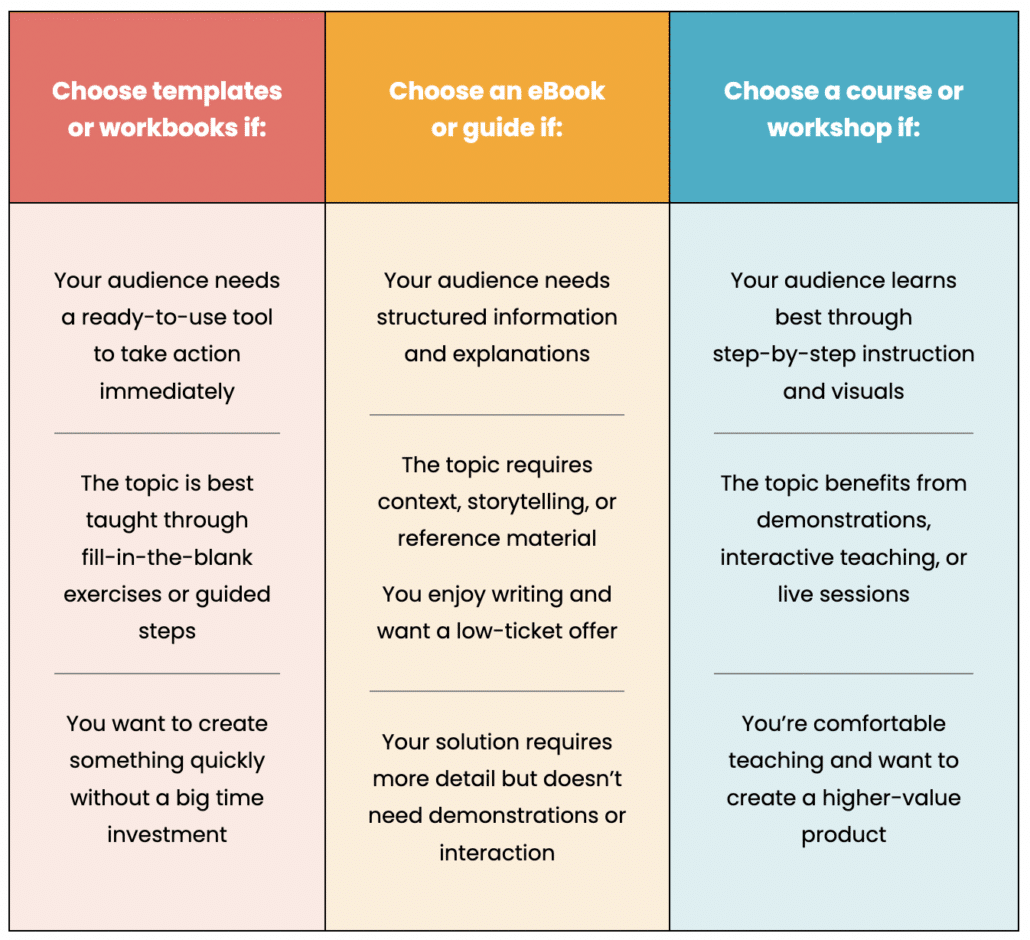
To sum it up:
Want a shortcut? Our bestselling Make It Sell It Toolkit includes hundreds of plug-and-play digital product and sales page templates to create professional digital products without spending hours on design or starting from scratch.
Step 3: Structure Your Product for Clarity & Ease of Use
Once you’ve chosen the right format, the next step is structuring your content so it’s easy to follow, engaging, and delivers real value. A well-structured digital product makes it effortless for your audience to consume, apply, and get results.
Use the “One Transformation” Rule
Every product should take people from Point A (problem) to Point B (solution). If your content is scattered or tries to cover too much, it becomes overwhelming. Keep the focus clear and actionable.
Make It Easy to Navigate
How your content is presented impacts how people engage with it. Structure it in a way that makes learning simple:
- For workbooks & templates: Use clear sections, checklists, and step-by-step exercises to guide users.
- For ebooks & guides: Break concepts into short, digestible chapters with summaries or key takeaways.
- For courses & workshops: Organize lessons logically and include supporting materials (slides, transcripts, exercises).
Keep It Actionable (Implementation is Everything)
Your audience isn’t just looking for information, they want to be able to apply what they’ve learned. The easier you make this, the more valuable your product becomes.
- For workbooks & templates: Include fill-in-the-blank sections, guided exercises, or checklists so users can immediately put your methods into practice.
- For ebooks & guides: Add practical examples, case studies, or step-by-step breakdowns that illustrate key concepts.
- For courses & workshops: Provide downloadable templates, worksheets, or action steps at the end of each lesson to help students implement what they’ve learned.
Bottom line: Don’t just tell, guide your audience through taking action.
Ready to Package Your Expertise into a Profitable Digital Product?
The biggest mistake digital product creators make? Spending too much time overcomplicating the process instead of structuring their content effectively.
Remember:
✔ Your knowledge is the value—not the format.
✔ Choose a format that fits your strengths and audience.
✔ Use tools and templates to simplify the process.
✔ Launch before you feel 100% ready.

