
The story of how I went from Ai telling me it “would not cite” one of my blog posts to “publish confidently!” in 3 iterations. If you’re a small business bloggers wanting to get cited by Ai tools, you’re gonna want to steal this process.
I spent hours writing what I thought was a comprehensive blog post about Google’s AI content policy. It covered all the things. I was proud of it.
On a whim, I decided to ask Perplexity if it would cite (send referral traffic to) my masterpiece.
First, I asked it what it was already citing as top sources so I could check out the competition:
🛠️ The Tool: Perplexity.ai
🤖 The Prompt:
How would you answer: [the questions my post answers]. What sources would you cite?
And just like magic, it told me! Competition research sure works differently these days, lol.
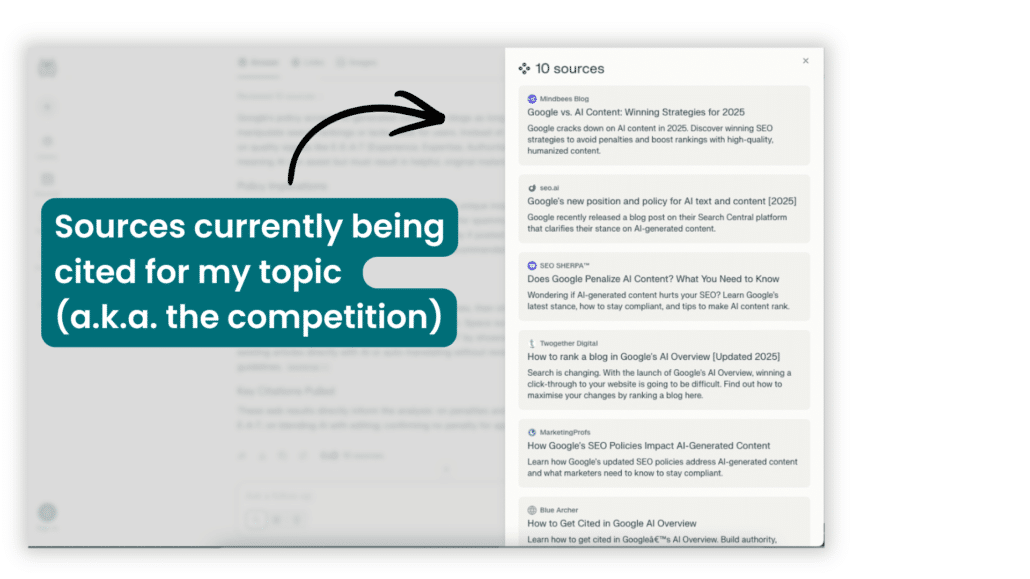
Then, with my blog post draft in hand, I asked this follow-up question to see if it would cite my post:
🛠️ The Tool: Perplexity.ai
🤖 The Prompt:
If someone asked you that question would you cite my blog post? Be honest about:
– Whether you would cite it or not
– What’s missing that prevents you from citing it
– What’s too surface-level
– What’s weak compared to blog posts you would cite
– Specific improvements that would make it citation-worthy
Don’t sugarcoat it. I need to know what’s holding this post back.
Here’s the post:
[paste complete blog post draft]
I pasted in my draft, hit enter, and…
Round 1: Computer Says No 💀

“No, this blog post would not be cited…”
– Perplexity
Then it proceeded to absolutely roast me:
- “The post relies heavily on rephrasing Google’s policy without fresh evidence”
- “Derivative rather than authoritative”
- “Cites secondary blogs but adds no unique data, case studies, or metrics”
- “Reads as opinion-heavy marketing for a lead magnet”
- “Surface-level elements”
- “No original research, no tool demos, no data”
😩 Ouch.
But Perplexity didn’t just leave me hanging. It gave me specific improvements to make to the post.
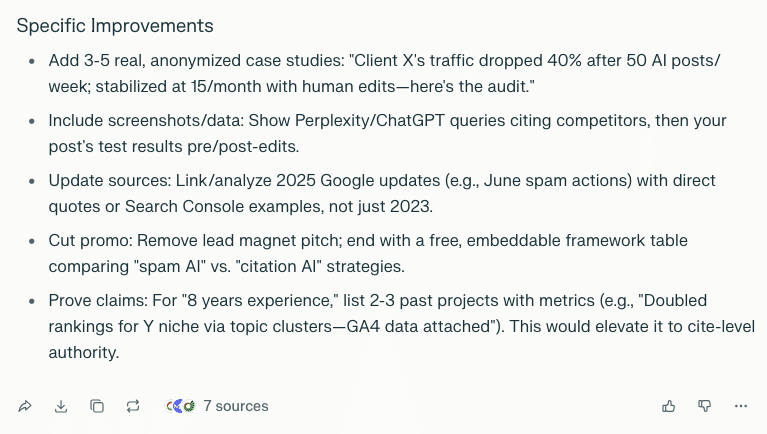
And well, yikes. 🫠
Looking at this list, I felt very discouraged. I’m not an SEO company like Ahrefs. I don’t have 23 case studies with traffic data, massive datasets from millions of sites, a research team analyzing Google updates, or enterprise tools…
I’m just a small business blogger sharing what I know and what I learn with my community.
It made me question whether I should publish the post at all, but then I remembered my own golden rule about blogging that has served me well for 20 years:
Write for humans, not just traffic.
This is a post that belonged in our content ecosystem.
But since I’m also actively trying to crack the code on how small businesses can survive AI and make their content citeworthy, I decided to see if I could improve it.
A couple more rounds of “computer says no” and I asked it point blank:
“Are you saying my content isn’t good or just not citeworthy?”
-Me
And I’m glad I asked this question, not because it soothed my bruised ego (lol), but because it highlighted something really important: it’s not about quality, it’s about proof.
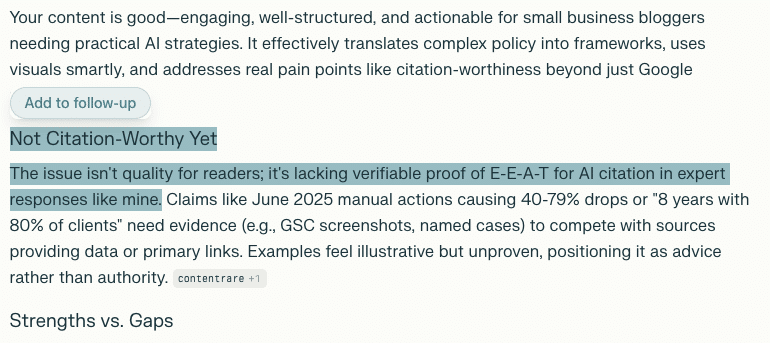
I Asked Claude for Help Brainstorming Ways to Pass Perplexity’s “Citation-Worthy” Test
Claude reminded me that I do have proof of expertise, experience, and authority.
✓ 20+ years of blogging experience
✓ A real community of business bloggers who trust me
✓ Prompts I actually use myself (not theoretical advice)
✓ Thousands of students who’ve used our blogging templates
✓ Survey data
Wait. I have a real audience of business bloggers that I actually talk to.
I remembered I had set up a simple survey asking them about their thoughts on blogging and Ai’s impact on the whole situation.
What would happen if I included those results in my post?
A Simple Survey Provided The Proof My Post Needed
I used Tally (it’s free!) to create a survey that took 10 minutes to set up and the results were so interesting… but I hadn’t thought to share it!
Here’s what it found:
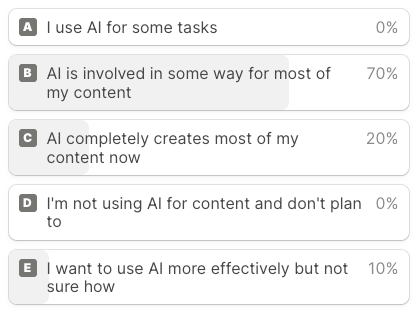
- 70% said AI is involved in some way for most of their content
- 20% said AI generates most of their content
That’s original data. That’s MY data. No competitor has this.
It wasn’t Ahrefs-level research with millions of data points.
But it was REAL.
It was MINE.
And it proved I had unique expertise related to the topic.
I Rolled Up My Sleeves & Improved The Post
I took the feedback seriously and asked Claude to help me translate Perplexity’s suggestions and see what we could do to improve it.
Claude was “on my side” and rooting me on while Perplexity remained the objective professor grading my work.
What I DIDN’T change: The CTA for my freebie.
Perplexity suggested I “cut the promo” to be more citation-worthy.
My response: No.

“Are you even serious, bro? I’m a small business owner. I need to grow my list. I’m not a massive SEO SaaS selling $500/month subscriptions. Removing my CTA just to make an AI tool happy would be shooting myself in the foot.”
The first goal for a business blogger isn’t traffic or citations, it’s conversions. A higher priority is to create content that generates leads and sales for my business (otherwise what’s the point?)
So I skipped that suggestion but worked through the rest one by one. Then, ran it through Perplexity again with the updated post…
Round 2: Computer Says… Maybe?
This time, it went a little easier on me. 😂
“This post is noticeably better with the real survey adding immediate credibility from your community. It feels like genuine help from a small business owner, which makes it relatable and useful for readers.“
-Perplexity
Progress! But still not quite citation-worthy. It told me the remaining gaps and specific tweaks I needed to make so I decided to give it one more shot.
I pasted the revised post back into Perplexity, saying:
“I’m just curious if this is better. I can’t compete with SEO heavyweights like AHrefs, but I came at it from a human perspective and shared what I learned from my audience.”
-Me
Round 3: Computer Says YES! 🎉
Perplexity’s final verdict:
“Yes, this pushes it solidly into citation-worthy territory. Publish confidently; it’s helpful, original, and now authoritative.”
-Perplexity
From “would not cite” to “publish confidently” in 3 iterations.
Freaking wow, right? And I didn’t even need to do all that much or follow every suggestion.
I went from feeling totally discouraged to feeling like maybe it’s not impossible for small business bloggers to survive the AI takeover after all.
What This Experiment Taught Me
Being Citation-Worthy ≠ Being The Biggest Authority
This whole experience: from confident first draft → to brutal feedback → to iterating and making minor adjustments to the post → to “publish confidently” taught me something important:
It’s not about being a giant industry site. It’s about having something original to say based on your work, your audience, and your experience. And remembering that you probably already have it, it’s just a matter of remembering to include it in your content.
It’s not hard, it just takes a little getting used to. Especially if you’re leaning on Ai to help you write your content, you want to edit that content to make sure your human fingerprint is on it.
The next time you write a blog post, try these”mad-libs” for adding something new and unique to the conversation:
✅ Original data (even small surveys count)
- “I polled my [X-person] list/email subscribers/waitlist and [stat] said…”
- “Quick Tally survey of my [niche] audience: [stat], but [surprising twist]…”
- “From [X] replies in my community chat: [stat] do [behavior]…”
✅ Your actual experience (first-person, specific)
- “Here’s the pattern I’ve seen [X] times…”
- “The exact mistake I made with my first [X] clients…”
- “In my [X] years helping [niche], this one tweak doubled [result]…”
- “Last [month/quarter], one student/client tried [thing]—here’s what happened…”
✅ Useful tools/frameworks (things people can use)
- “Steal my [X-second] checklist: Tick [Y]/Z before publish…”
- “Copy this table I use weekly: [Column1] vs [Column2]…”
- “Paste-ready prompt: ‘[prompt starter]—swap in your [detail]…'”
✅ Proper citations (link to real sources)
- “[Authority]’s exact words: ‘[quote]’ [direct link]…”
- “Per [official doc/report], [key fact] hit in [date]…”
It’s really just as simple as that. You do NOT need:
- ❌ Enterprise tools
- ❌ Massive datasets
- ❌ A research team
- ❌ To sound like a corporate robot
Small business owners can create citation-worthy content. We just have to learn what signals these tools are looking for (and it’s not as intimidating as it seems at first glance!) and lean into what makes us original.
Steal This Process
Here’s the exact process I used. You can copy it:
Step 1: Write Your Draft
Step 2: Test It With This Prompt – Run it through Perplexity BEFORE you publish:
How would you answer: [THE QUESTION YOUR POST ANSWERS]
If someone asked you that question, would you cite my blog post?
Be honest about:
– Whether you would cite it or not
– What’s missing that prevents you from citing it
– What’s too surface-level
– What’s weak compared to blog posts you would cite
– Specific improvements that would make it citation-worthy
Don’t sugarcoat it. I need to know what’s holding this post back.
[PASTE YOUR DRAFT HERE]
Step 3: Read The Feedback
It’s going to sting. Read it anyway.
Look for patterns in what’s missing:
- “No original data” → Survey your audience
- “Too generic” → Add YOUR specific examples
- “Surface-level” → Go deeper on one thing
- “No citations” → Link to actual sources
Step 4: Find YOUR Unique Angle
Ask yourself: What do I have that competitors don’t? Add YOUR data, YOUR examples, YOUR stories.
Step 5: Rewrite & Retest
Run the same prompt with your updated draft.
Did it improve? Great. Still not there? That’s okay. Iterate.
I needed 3 rounds. You might need more. You might never get there and that’s ok too…
Step 6: If It Serves Your Business & Audience, Publish The Dang Post
Remember: If this content is serving your audience and your business, publish it anyway. We can try to rank and we can try to get cited and do our best, but what we can’t do is settle for being invisible to our audience.
✓ Write for your people.
✓ Keep your business goals central to what you’re doing.
✓ THEN optimize for search and AI citations.
Never Give Up. Never Surrender. 🚀

Yes, AI overviews are siphoning traffic.
Yes, the internet is noisier than ever.
And yes, the rules have changed.
But the good news is that Ai has leveled the playing field and business bloggers are in a great position right now. Which is why I’ve been behind the scenes for the last several months working on something amaaaaazing to help you:
Get Your Blog Ai-Ready
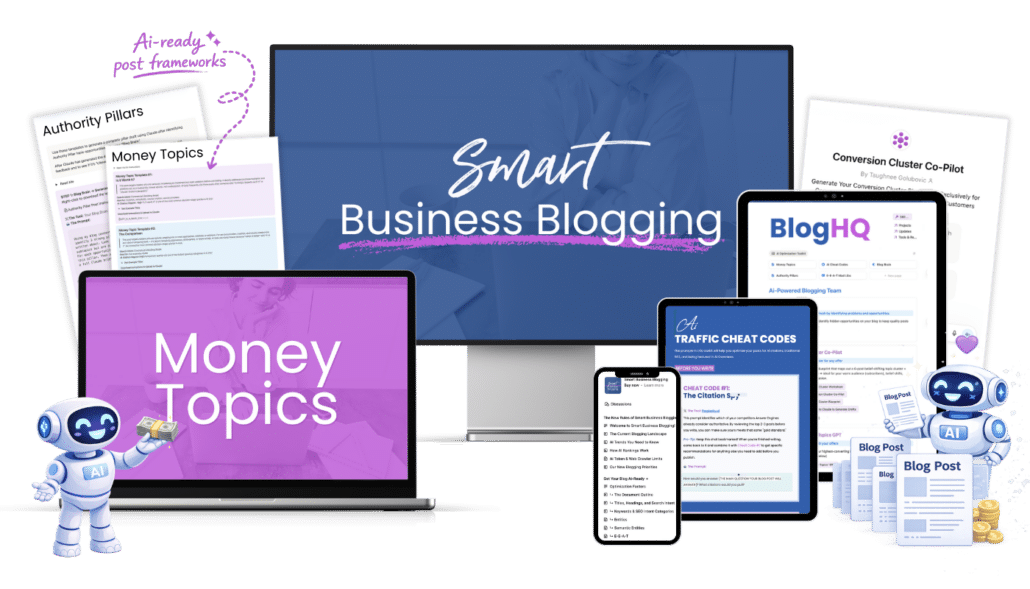
Helpful prompts are great (and there are a lot more where those came from), but Smart Business Blogging is an entire reset button for business bloggers who want to stop working for Google and start planning content that’s both citation-worthy, rank-worthy, and conversion-focused.
If you want your content showing up when AI tools are having conversations with your customers, learn more about Smart Business Blogging here.
FAQs
Can small business bloggers really compete for AI citations against large enterprise sites?
Yes! Ai doesn’t work the same way as traditional search. If you have the information AI needs to generate a complete answer, and if you’re a trustworthy source, you can actually “skip the line.” Prioritize original data and unique perspectives over sheer volume. This provides the evidence that AI models like Perplexity (and ChatGPT, Gemini, etc.) require to verify your authority and expertise.
How do I provide “proof of expertise”?
Sharing results (such as case studies, original research) and unique human insights (such as “what I learned from failure” stories) demonstrate that you’re adding to the conversation, not just regurgitating what everyone else has already said. This “Information Gain” is exactly what Ai platforms are actively hunting for.
Should I use AI tools to audit my content before I hit the publish button?
Yes, and this is a GREAT use case for using AI in your blogging workflow – this is the “grunt work” that we should be offloading to AI to make our content competitive. The AI Traffic Cheat codes can identify gaps, help you structure your content for AI citations, and stress-test your posts to see if they’re citeworty before you hit publish.


"Computer Says No" really stood out to me, as it's a harsh reality many of us face when trying to get our content noticed. I've found that adding specific data points and statistics can make a big difference in getting a positive response. For instance, including numbers like GDP per capita or unemployment rates can add credibility to a post. The parallel between using AI tools to evaluate content and comparing economic indicators between countries is something I have been thinking about because it highlights the importance of using reliable data to make informed decisions. I wonder, as you refined your post, did you consider how the process of iterating on feedback from AI tools might be similar to how policymakers refine their strategies based on economic data?