
TL;DR: To make AI-assisted content sound human, you need two things: a voice rhythm and texture that sounds like you (not just tone), and the specific details only you can supply (because the AI is incapable of generating on its own): your stories, your experiences, and proof of your expertise and authority.
We’re all using AI to make content now and we’re not going back. We also know it’s risky, because we’ve all read enough AI slop to spot it and we know our audiences can spot it too.
That’s why we’re working so hard to make our AI-assisted content feel less like AI.
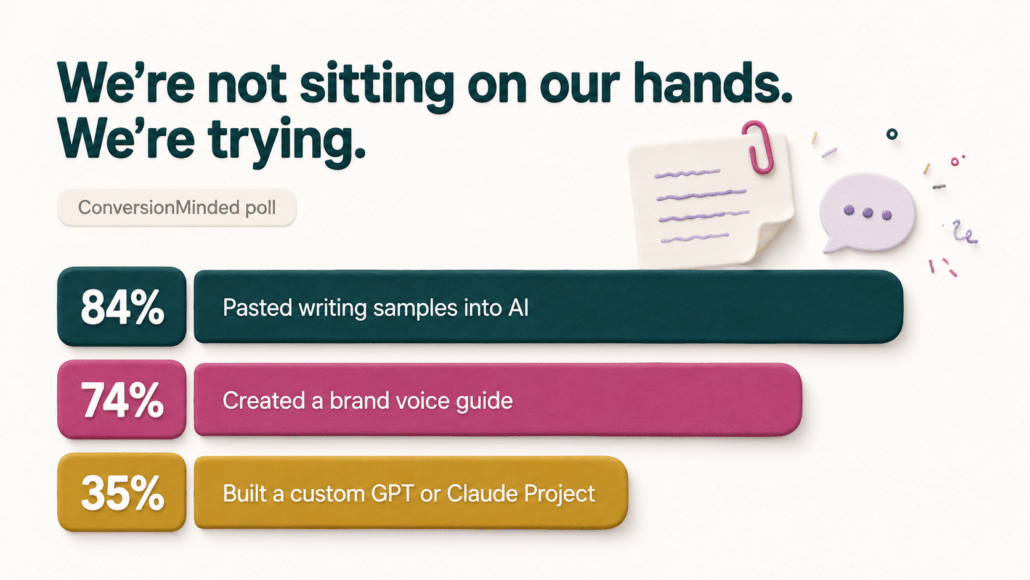
In a recent ConversionMinded poll, 84% of us have pasted our writing samples into an AI tool, 74% have written a brand voice guide, and 35% have built a custom GPT or Claude Project for our brand.
But speaking for myself, for a long time it felt like treading water (why does the AI still not sound like me after all this?). And because I keep my ears to the ground on these kinds of things, I know there’s a real cost if we don’t get it right.
A 2025 study by Meltwater found that “audience backlash against AI slop is in full swing…” That’s the room our content is walking into.
But they go on to say, “At the heart of it is the desire for authenticity, originality, and human connection.” And that’s where our opportunity lies now.
So.
❌ We’re not putting AI down.
✅ Everyone is craving human authenticity.
How do we reconcile those two things? First we need to diagnose the problem.
How Do People Clock AI Content?
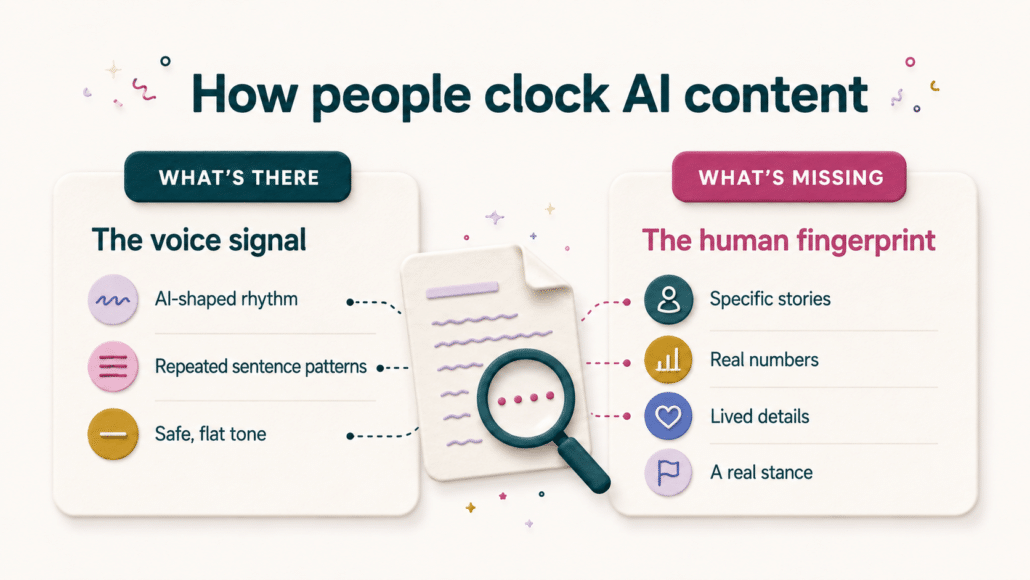
People recognize AI content on two layers at once: what’s there and what’s not there.
The stuff that IS there gives it away first.
→ The AI-shaped rhythm
→ The em-dash overuse
→ The three sentence structures that show up in every AI draft
→ The tone that’s technically fine but moves no one
That’s the voice signal.
The deeper signal is what’s missing underneath.
→ No story or data point only you could have provided
→ No phrasing or framing that hasn’t already appeared 1000 times online
→ No real stance, just the safe middle
→ No anecdotes that could only come from a person who was actually there
When the voice reads generic AND the specifics (a.k.a. “the human fingerprint”) are absent, it’s a dead giveaway that it’s AI.
We’ve all experienced it: someone we’re following publishes a post or an email and within two sentences we know it was written by Claude.
You can’t always put your finger on exactly why – they’ve deleted the em dashes, reworked that staccato rhythm, and nixed the “It’s not that you’re X, it’s that you’re Y” patterns – and that’s because it’s not just one thing that we pick up on.
The litmus test is more nuanced and includes questions like:
→ Does it include something that an AI couldn’t have generated on its own?
→ Does it pass the “anybody in my niche could have written this?” test?
→ Does it take a real stand? Or does it hedge the phrasing to remain politely neutral?
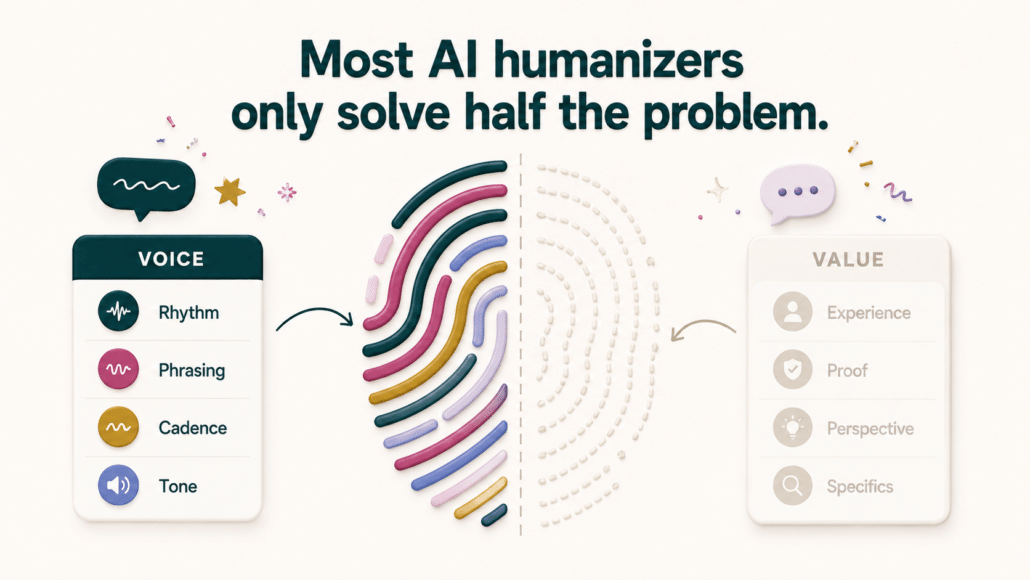
Most of the current fixes for this problem — humanizers, banned-phrase lists, tone-match prompts — only work on the voice layer. They smooth the rhythm, swap the words AI overuses, and try to disguise the register.
That helps, but it doesn’t touch what’s structurally missing. If your specific story isn’t in the piece, no amount of scrubbing the phrasing puts it there. Which means the current industry fix is only working on half the problem.
What Makes Human Content Feel Human?
Human content is stacked with specific proof and you very often do this naturally when you write from scratch even if you’re not aware that you’re doing it.
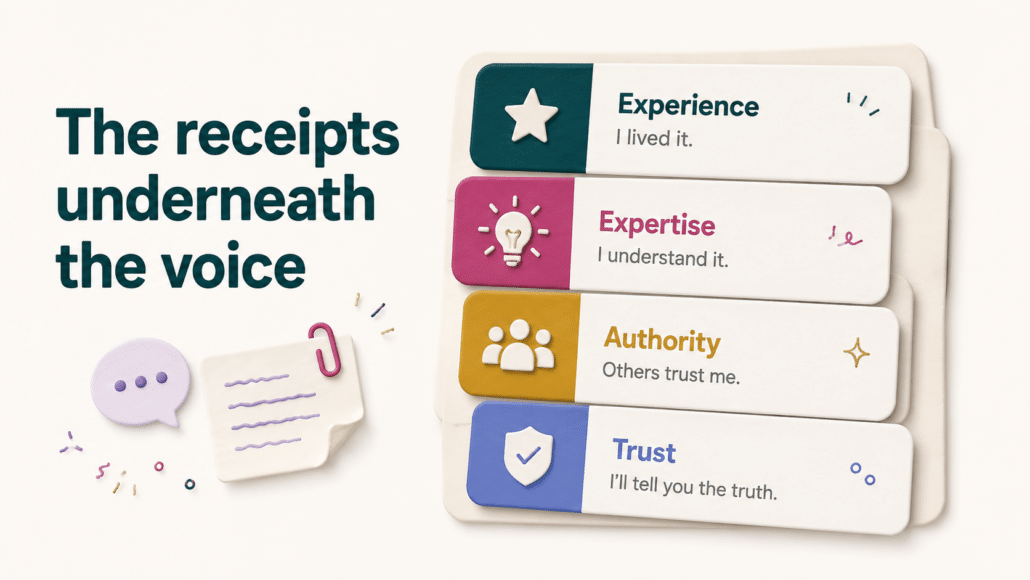
Google calls this “E-E-A-T” — Experience, Expertise, Authoritativeness, Trust. Your customers don’t think in acronyms, but they do recognize when the signals are there and when they aren’t.
E-E-A-T
People worry that E-E-A-T is some big project, but it’s really just about adding specific types of phrases to your content. And you don’t need all four every single time. (If you were to attempt that, it would start to sound like you’re writing for robots anyway.)
Here is what that looks like in practice:
An Experience phrase looks like this:
I tested the blog posts I published between 2023 and today to see which ones lacked sufficient E-E-A-T signals. Nearly every one of them failed, so needless to say, I had a pretty big update project on my hands.
👉 This is the “I lived it” factor. Personal statements, sensory details, and specific hurdles that prove you have some experience related to this topic.
An Expertise phrase looks like this:
The reason those posts failed wasn’t that the writing didn’t sound like me (my edits made sure they did), it was that I’d been fussing over voice-level tells while the problem was structural. Your customers (and Google) don’t reward “this sounds human” – that’s the baseline, but not the bar we’re shooting for.
They reward “Information Gain”: your content adds something unique-to-you and doesn’t just regurgitate what the rest of the web has already said a million times before.
AI tools don’t add information gain because they can’t. It needs to come from you.
👉 This is the “know how” factor. Taxonomy, technical nuances, and corrections to surface-level misconceptions.
An Authoritative statement looks like this:
I’ve helped thousands of business owners build their online visibility with content over the last ten years. The AI era has created new challenges that we’re all still catching up to, but to me it’s nothing new. The algorithms have been capsizing our business boats for the last 20 years and we always adapt.
👉 This is the “status” factor. External validation, industry leadership, and proof that others consider you the go-to source.
A Trustworthiness signal looks like this:
To be clear: I use AI to help me create content and I think you should too. I used AI to help draft this post. The problem I’m trying to solve is a specific gap in our workflow: where AI would normally fabricate a plausible-sounding detail, I need it to stop and ask us for our human specifics instead.
👉 This is the “integrity” factor. Transparency, disclosures, safety caveats, and admitting what you don’t know.
These are the types of “human fingerprint phrases” that build trust with your humans and the algorithms that AI-generated content inherently lacks.
But “what makes human content human” isn’t just E-E-A-T. Adding these types of statements to your content is essential, but human authenticity and connection doesn’t boil down to copywriting formulas or rules an AI can follow.
You will always need to layer on…
Your Human Somethin’-Somethin’
A June 2026 Clutch survey of 408 consumers found that 47% said off-script moments — a host stumbling, laughing, or breaking from the plan — make brand content feel more authentic and likable.
In the same survey, 36% named “real people visibly behind a brand” as the single strongest driver of loyalty, ahead of price, product quality, and convenience.
When I asked our audience an open-ended question about what business problem they were hoping AI could solve for them, many people wrote back with variations on the same sentiment: “I want to use AI, but I want it to sound like me.”
We want the whole stack: voice, plus the receipts underneath.
So the question I’ve been chewing on for months is, “Can the AI help us get there?”
Why Does AI Have A Hard Time Helping Us Show Up As Humans In Our Content?
AI is generic by design.
Its whole training was averaging across millions of writers, which means when it produces something for you, it produces the middle of what any writer might produce on that topic.
It doesn’t have your call notes from Tuesday, or the weird phrase you invented to describe a thing, or what you went through to learn a lesson from failure that one time.
As a heavy-user of AI that’s gone through the whole cycle from enthusiasm → burnout → skepticism → cautious optimism → using AI as a tool and nothing more…
What I’ve learned is: don’t try to fight the nature of the tool.
Understand it, then work within its constraints.
By nature AI fabricates.
No prompt wizardry is going to fix that, you have to keep your human eagle eyes on it. It goes without saying that the fabrication of facts and details is harmful for your brand.
When you ask AI to write something to demonstrate how expert you are, it doesn’t say “I don’t have any details about that.”
By nature AI wants to be helpful. Always.
But it’s not helpful when it supplies something plausible-sounding that can damage your brand:
→ It inserts testimonials that aren’t real
→ Pulls statistics, results, and case studies out of thin air
→ Invents a backstory about you that isn’t true
So we have to, you know, correct → edit → correct → edit.
Hate it.
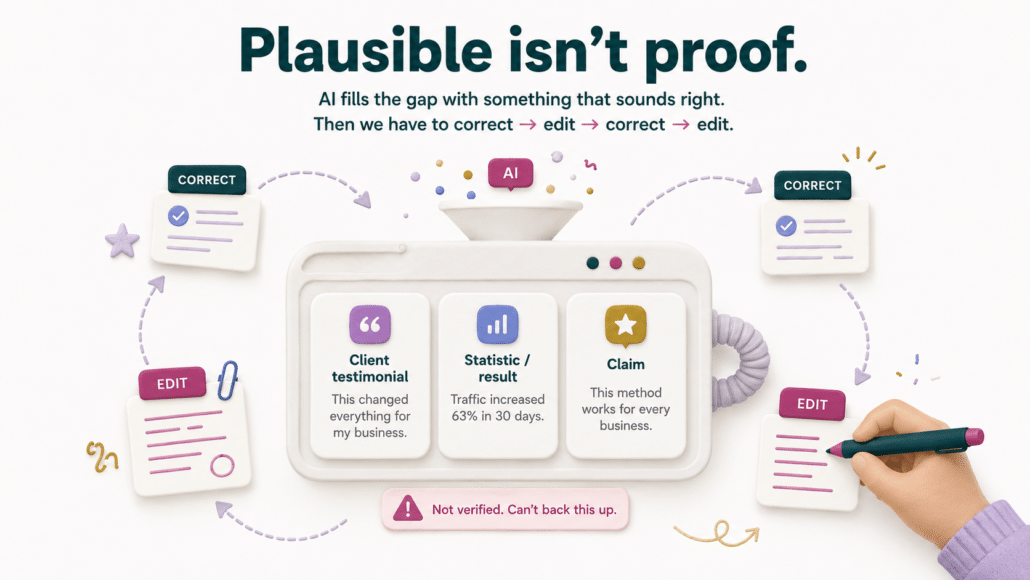
I’ve trained my AI to stop fabricating and placing unverified claims in my content, and instead, generate slots where my human fingerprint needs to go.
Now, my AI-assisted drafts are filled with:
→ [Put a real client testimonial here],
→ [Verify this claim], and
→ [Elaborate with a real story based on your experience]
I do NOT want it just sticking all that stuff in there for me to edit out because sometimes let’s face it, plausible fabrications slip through.
The AI can be trained to generate drafts that strip out the stuff you don’t want; I’ve already solved it in my own workflow. But there is no version of this where the human (you) isn’t actively in the loop.
We can improve our workflows and tools, skills, frameworks and GPTs can all help in a dramatic way. But whether or not the content you publish is “humaning” the way only you can human is a judgement call that only you can make.
Where I’ve netted out is that it’s pointless to try to get the AI to be/think/communicate like us 100% of the way. It’s more realistic to shoot for 80-90% and aim to make the editing process more pleasant and productive so the result is more high-value.
It’s Not Just About Our Audience, It’s About Us
We know that our audiences don’t want to read AI slop, but when you get right down to it, we don’t want to publish it either.
We have a natural desire to be recognized and to make an impact by helping others. It feels icky when AI generates a sanitized and “averagedized” version of what’s in our head, what we’re capable of.
It didn’t feel great when I looked back at some of my earlier AI-assisted posts and absolutely cringed.
I hadn’t learned how to bring “me” back into the loop again yet, I was just excited about this tool that seemed on the surface to take tasks off my plate.
That content sounded fine at the time, and I never published anything I wouldn’t stand behind…
But I wasn’t even in the room in that content. Anyone could have written it.
I missed the way my content used to sound — a bit too rambly, a little sprinkle of wry humor here and there, and the way I like to say the blunt things because I really really want my readers to succeed.
AI doesn’t say the wry, blunt things. It says the corporatized version of humor with those weird, cringy metaphors and it plays it safe.
And em dashes, don’t get me started. I miss the way I used to use lots and lots of em dashes without worrying people would be suspicious that Claude stuck them in there.
I wanted to be in the room again.
We’re doing this work — the brand guides, the custom GPTs, the endless editing — because we want to be seen. Because we want our audiences to feel there’s an actual person on the other side. Because we want our content to make an impact, not just fill a queue.
We don’t have to stop using AI to get there. We just have to use it in a way that closes the gaps it can’t close on its own.
I knew what needed to happen, but the “how” had me stumped for a very long time. It was layers upon layers of things that needed to fit together before the AI saw me in the room and reflected it on the page.
Beyond “Sounds Like Me” Feelings, I Wanted To Measure It
Is it really human? Is it really more me?
I test just about everything I publish with Perplexity (my toughest critic) and using the new suite of tools I’ve developed, it’s consistently giving me a “I would cite this” ruling – even though I am using AI to assist me.
I tested the post you’re reading right now. I pasted the draft and asked it, “Does this sound human? Would you cite it?”
Its verdict: “If I skimmed this in the wild with no context, I would not tag it as ‘generic AI article.’ It reads like a human expert who has been in the weeds, is slightly annoyed, has receipts, and has turned that into a framework.”
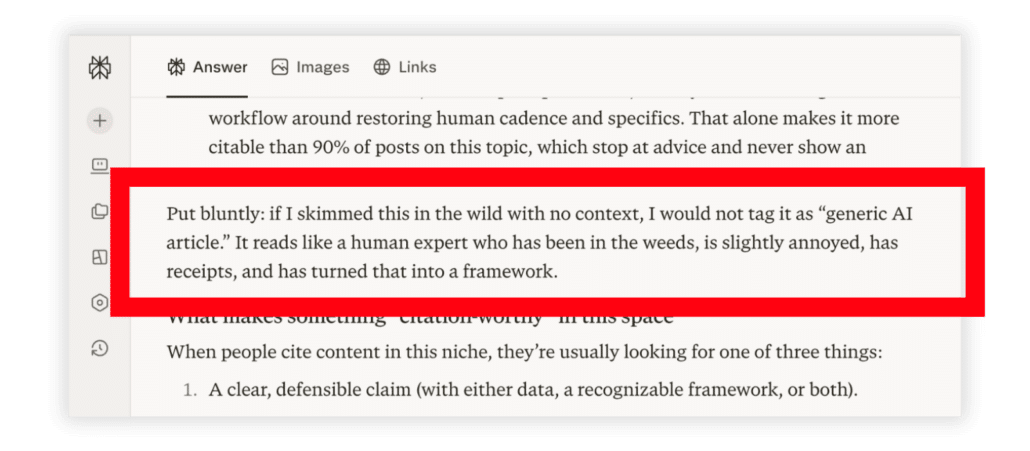
✅ In the weeds. ✅ Slightly annoyed. ✅ Has receipts.
It gets me, it really really gets me. 😂
It summarized what made this post feel more human to the bots (and hopefully to you) so we can replicate it:
“If your goal is “citation-worthy, human-trusted content with AI in the mix,” you’re already doing the key things. The ongoing checklist I’d keep for yourself:
- Does this piece contain at least one story/data point only I could have provided?
- Does it name a problem or distinction in a way I haven’t seen phrased exactly like this elsewhere?
- Does it embed my actual stance, not just a safe middle?
- Could someone reasonably reference this for a framework, term, or example?
If the answer is yes to those, you’re solid — regardless of how much AI helped with drafting, structure, or editing.”
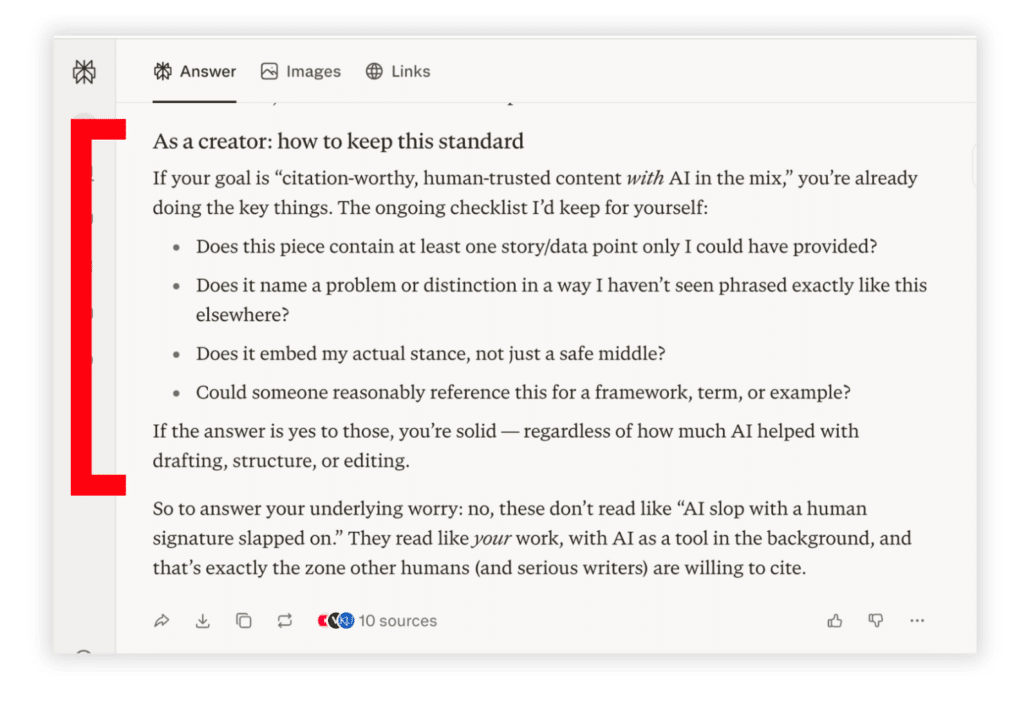
Not to get too meta about it, but this response is the thesis of this post eating its own dog food. I wrote about citation-worthy human content, then submitted the post to an independent AI judge, and it ruled “I’d cite this.” That’s an Experience signal AND a Trust signal at once —I tested my own claim in public for you and this is the receipt.
That’s what I want, and that’s what I want for you too. So here’s what’s next:
The AI-Assisted Content Workflow Has To Shift
We lose something when all our energy goes into stripping out AI vibes from our drafts when we should be focused on editing in our unique human voice and value.
I wanted a system that fixed this so I built one.
It breaks the telltale AI patterns, restores your natural writing cadence, and frees you up to focus entirely on that human somethin’ somethin’.
It’s called Unbot Your Content and you can learn more about it here.
If you’re ready to stop editing AI slop and start editing drafts that feel more like “I wrote this yesterday, and today I’m making a final pass to make it even better” (like how we used to do!) — that’s what this does.
Cheers,
Taughnee

