Stop describing your voice to AI. Measure it, install it, and let it write like you every time.
Capture the unique qualities of your natural voice: the rhythm, the logic, and the habits that make you human. Then, turn those into rules your AI can actually follow.
Founder’s pricing · Limited time only · $97 $197
You’re using AI to create content, but it still doesn’t “get you.”
It approximates your tone, but it still sounds AI, so you’re trading one painful problem (writing from scratch) for several other problems:
→You spend all your time editing the “AI-ness” out of your drafts instead of focusing on sharing your value
→Your audience wants to hear the stories that only come from your lived experience, but the AI can only fabricate them
→You worry that your content isn’t driving results for your business because it sounds the same as every other business using AI
Unbot Your Content fixes this by measuring what makes your voice recognizably yours and creating better rules for your AI to follow.
Now, your AI’s job is to help you be more you in your content, not just generate words for you.
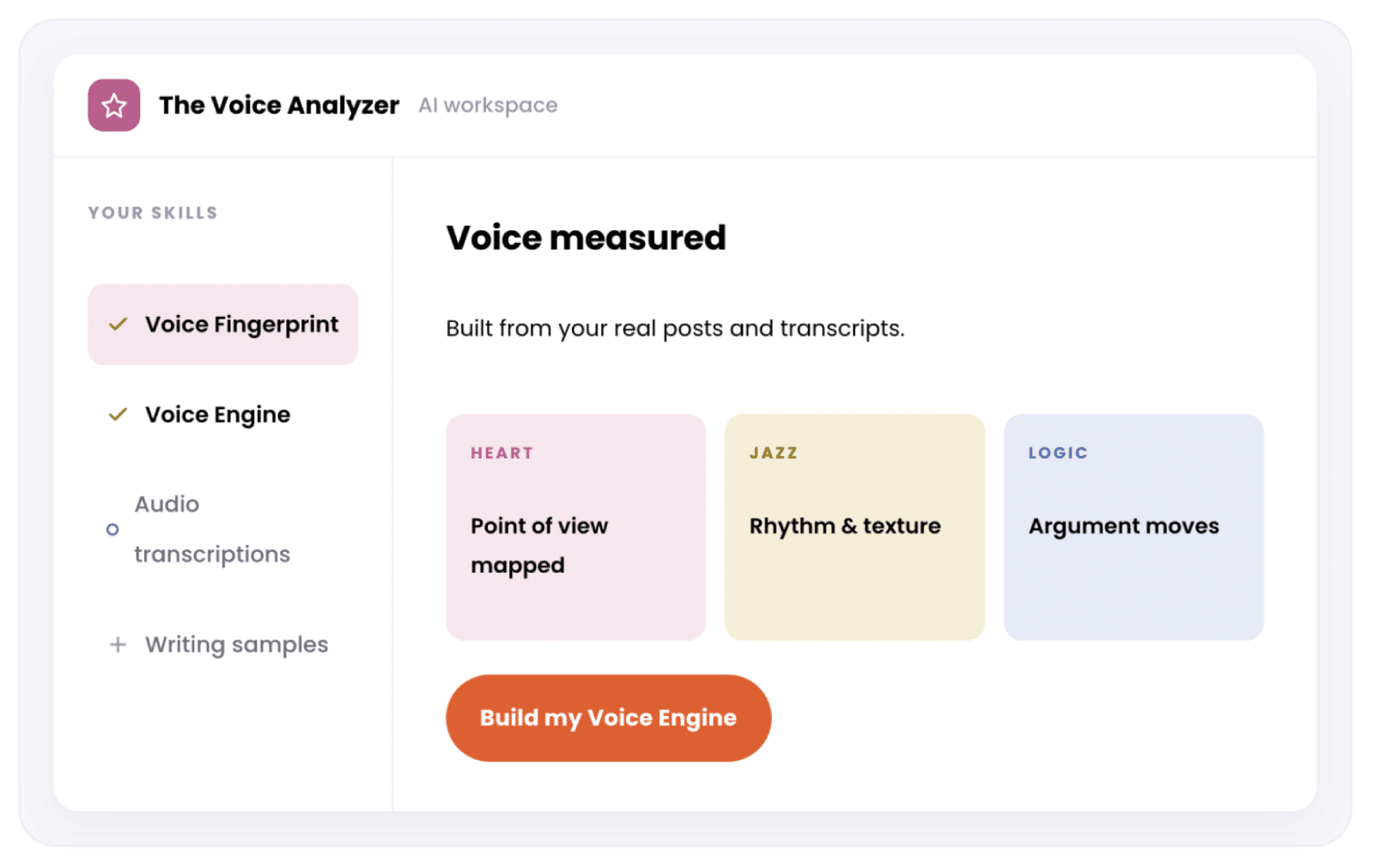
Your Voice AnalyzerMost “make AI sound like you” methods get the AI to eyeball it and pattern-match on the surface. The Voice Analyzer executes scripts that actually measure your unique writing and speech patterns.
You’ll set it up as a Claude project so you can come back to it as needed to fine tune your voice rules over time. (If you’ve never used Claude before no worries, I’ll walk you through it.)
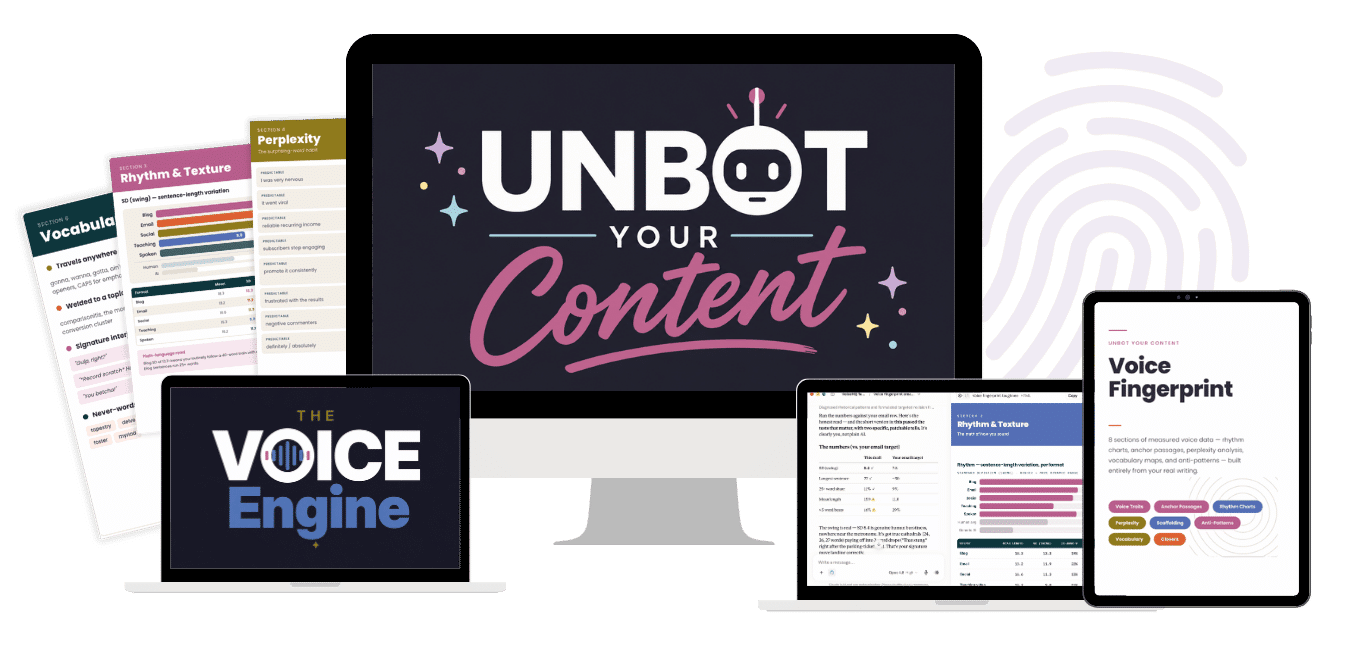
Your Voice FingerprintYou’ll get a beautifully-designed report that details your unique way of communicating. These are the characteristics that make you a trustworthy, likable human and the things AI can’t generate on its own.
Once you see it, you’ll understand exactly why your natural voice is so powerful and you won’t want your AI to strip out those qualities ever again.
Your Voice EngineOnce your voice analysis is complete, Claude will turn it into rules your AI will know how to follow.
Set it up as a Claude skill or upload to a ChatGPT project or custom GPT (I show you how step by step).

“Impressed doesn’t even begin to describe how I feel about this. You have created yet another great thing. I compared one of my old AI-started blog posts to what the Voice Engine wrote and the results are spectacular to see.”
Jake Van NessMarketing Consultant & Podcaster
“I was surprised by how clever this product is, it gets to the heart of the problem. It’s going to save me hours per week. Business voice is a real pain point and I’m thrilled with this solution.”
Claire BurrowsClinical Lead
This isn’t just another “make AI sound like you” exercise that leaves you with copy that still sounds like AI.
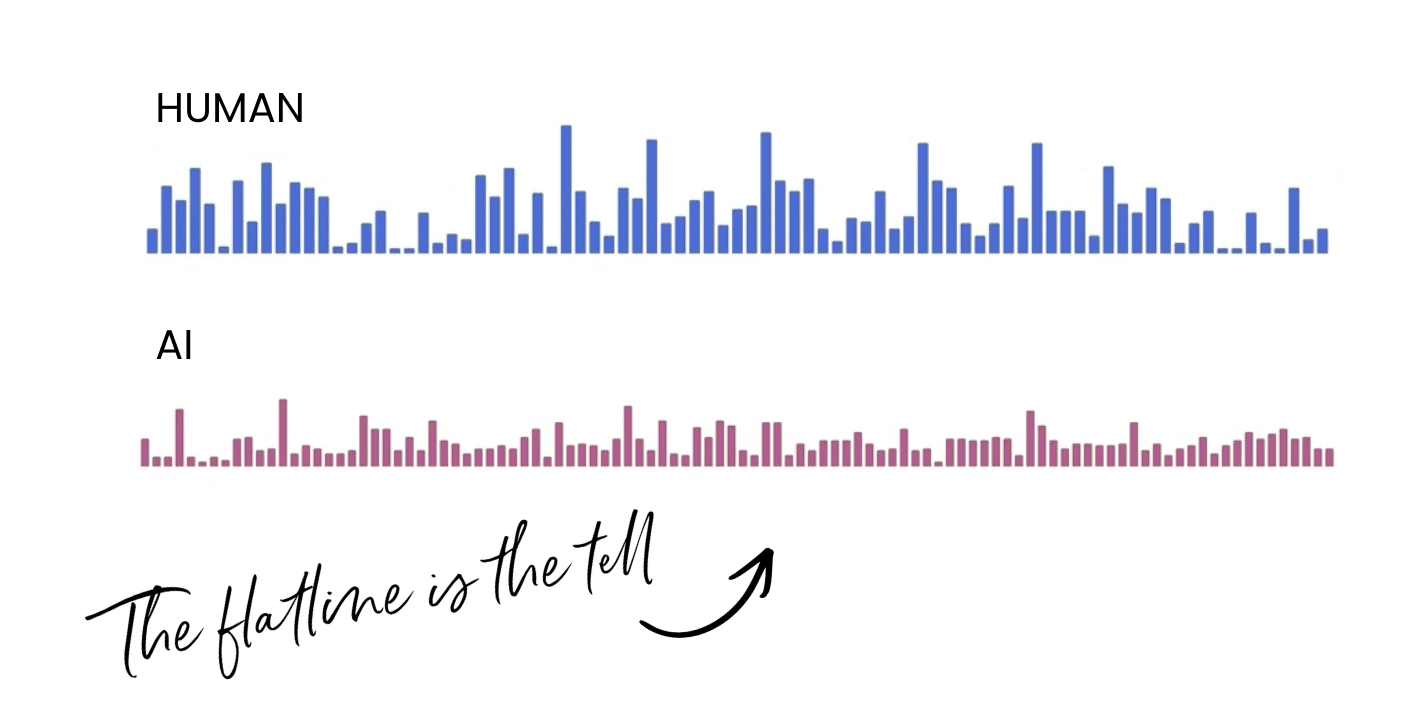
One of the reasons we can spot AI writing is because its sentence lengths fall within a narrow range, producing a predictable, clockable rhythm. It’s a flat hum.
Human writing is “bursty” and irregular. We naturally cluster ideas into a mix of extremely short, punchy sentences and long, elaborate ones. We’re jazz.
This “burstiness gap” is a major difference between human and AI writing. And it’s why giving the AI adjectives that describe your tone isn’t enough to make it sound like you.
Some AI models can fake the average human rhythm better than others, but they still aren’t writing in your rhythm.
The Voice Analyzer measures the things that capture the nuance and texture of your natural voice.
The Heart — Who you are on the page.
- The stances you take that a “balanced” AI would sand off
- Whether you write beside your reader, one step ahead, or from the podium
- Your proof style: stories, receipts, data, or lived experience, and where you deploy it
- What you do when you can’t back a claim: honest gap vs. AI’s confident fake
The Jazz — Your rhythm & texture.
- How much your sentences swing in each type of content you create
- Which punctuation moves you reach for and the ones you never touch
- How often you show up as “I” vs. staying behind the curtain
- Whether you reach for verbs or pile up nouns, counted against the AI average so you can see the gap
The Logic — How you build an argument.
- How you open: naming the reader’s real situation vs. announcing a principle
- Your reframing moves, and who’s allowed to hold the wrong belief when you flip it
- Where proof sits inside your argument, and how much you deploy before the ask
- How you land: the verdict-first close vs. the slow build, and how often you’re allowed to use your best trick
These are the things an AI can’t average its way into because they’re measurably and uniquely yours.
The Voice Analyzer
The Voice Analyzer executes code to analyze your real content samples and then walks you through a Cringe Test and Punctuation Flight so the rules it generates for your AI to follow are based on your specific style and preferences.
You’ll set it up as a Claude Project during the training and keep it active so you can come back whenever you want to refine your voice.
At the end of your voice analysis you’ll have your Voice Fingerprint (the report for the human) and your Voice Engine (the rules for the AI).
The Voice Fingerprint
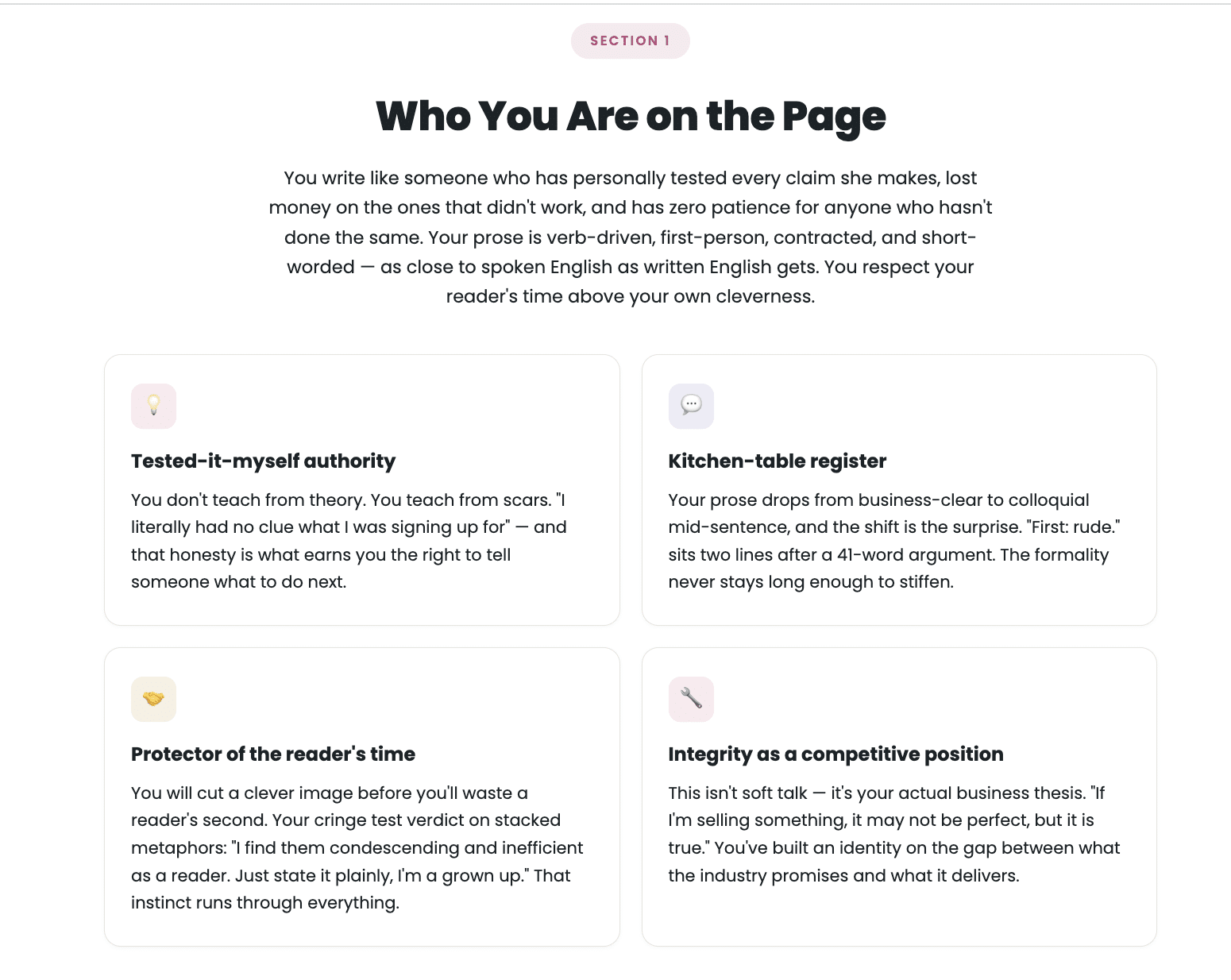
The Voice Fingerprint shows you what makes your communication unmistakably yours: the rhythm you fall into, the moves you reach for when you build an argument, the words you use that almost nobody else does, and the habits you didn’t know were habits.
Don’t be surprised when you read it if you feel a little seen. It shows you the strengths that AI has been stripping out of your content so you can recognize yourself again.
What’s in yours
Who you are on the page
Your North Star anchors
Rhythm & texture, measured
Your logical scaffolding
Vocabulary that’s yours
Your anti-patterns
How you close
The Voice Engine
The Voice Engine takes your voice analysis and turns it into rules an AI can follow without defaulting to surface-level pattern-matching from your samples.
You’ll use it every time you create content so your drafts sound the way you think, write, and speak. That way, editing is less about “stripping out the AI tells” and feels more like you’re polishing up something you wrote last week.
Here’s the thing:1 AI defaults to the average, so it hands you content that is competent, polished, and instantly forgettable2. The sentences sit in the same range. The rhythm never swings.3 Every draft reads like it could have come from anyone, and no amount of prompting seems to change it. That’s not a flaw you can prompt away, it’s how the model was trained.4
I fought with AI to generate drafts that sound like me for three years before I decided to get to the bottom of it.1 First, these tools are trained to produce the next most probable word so the result is an average of everything they’re trained on.2 Uploading brand guides don’t fix it because tone is something the AI will try to average too. The Voice Engine runs on my measured rhythm and argument moves so the drafts come back sounding not 100% me, but like something I wrote that needs a polish.3 Booyah.4
Included is a short but actionable training where I walk you through every aspect of getting your Voice Analyzer set up and installing your Voice Engine rules as a persistent skill for Claude or inside projects or a custom GPT in ChatGPT. Even if you’re a total AI beginner, everything is broken out in simple-to-follow steps.
No Fabrication
Most AI tools fake your proof. This one catches it before you publish.
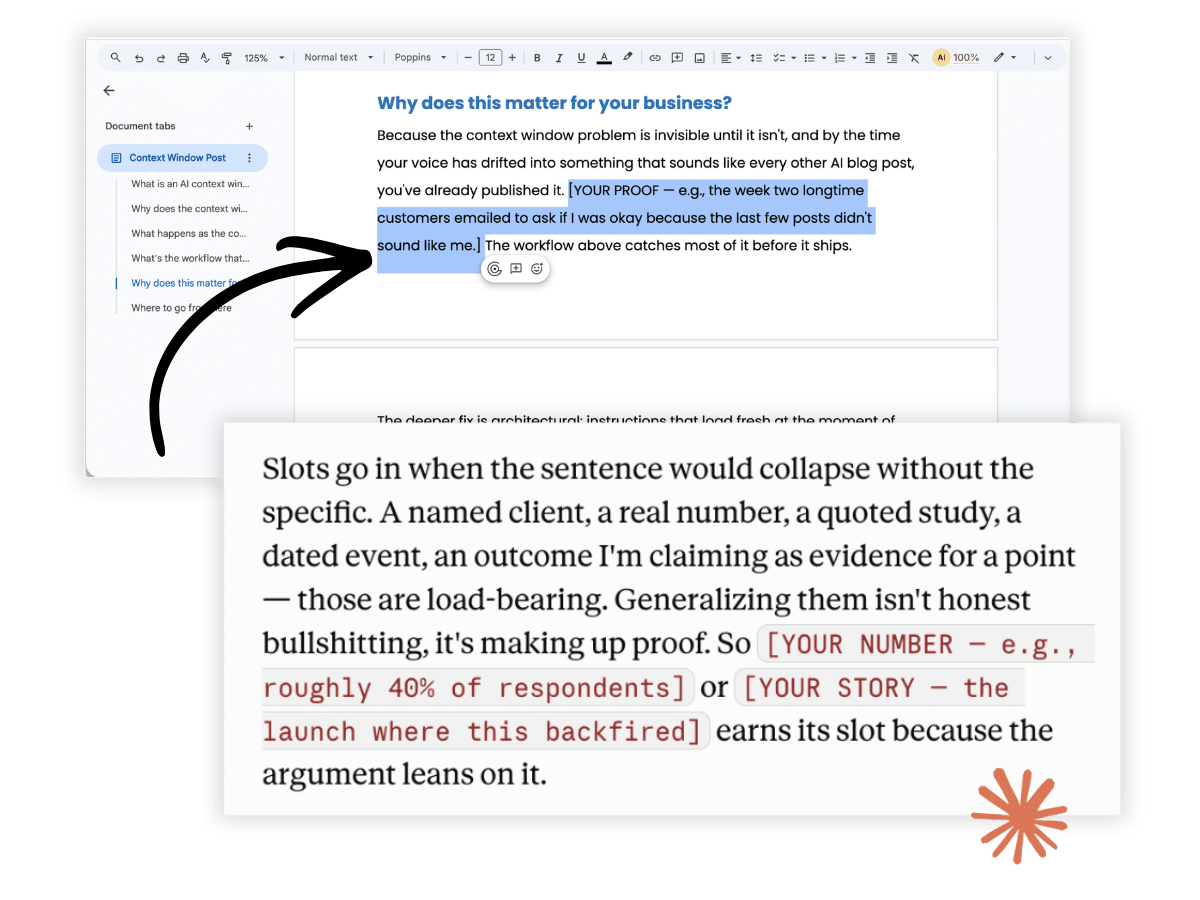
AI is trained to fill in details with something plausible, and very often it just makes things up on your behalf. (Ever have it insert a customer testimonial and you’re like, “Wait, who’s Susan?”)
Your Voice Engine is trained to spot when a sentence carries proof weight (a named client, a real number, a specific outcome you're claiming as evidence), and it leaves a labeled slot for you to fill in with your specific details instead of fabricating one and generating bogus claims you need to catch and re-work in your edits.
Plus these bonus skills!
Three companion skills that make your Voice Engine work harder, plus one that disappears when the timer runs out.

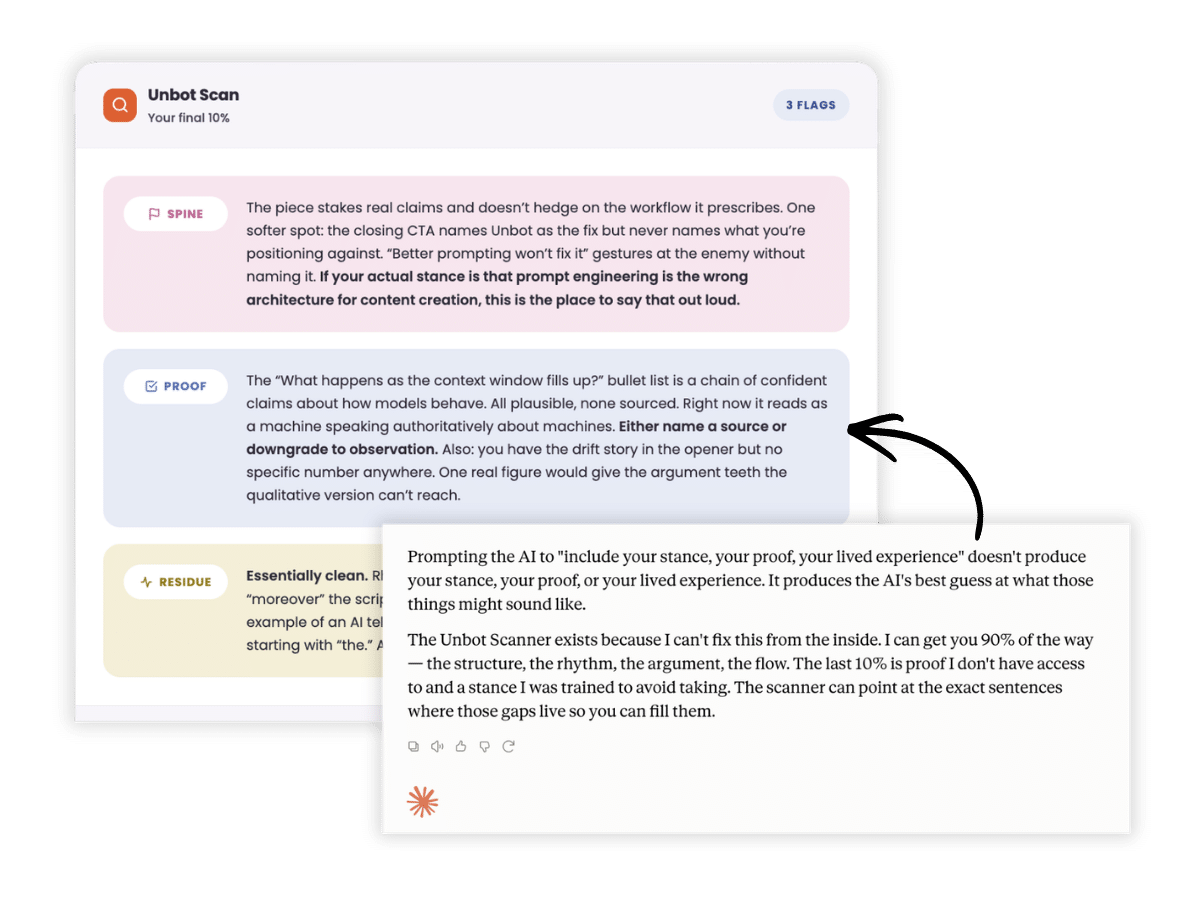
The last 10% AI structurally can’t do.
The Voice Engine got you 90% of the way. The Unbot Scanner shows you the last 10% that requires your human fingerprint. It never rewrites your draft, it just shows the three things AI structurally cannot supply:
Spine
AI doesn’t have a spine. It was trained to be balanced and inoffensive, so it literally cannot take a real stand. The Scanner flags every spot the draft went neutral on something you probably have an opinion about, so you can plant the flag.
Proof
The exact spots crying out for a real client story, a specific number, a case study you actually lived. This is the EEAT signal AI can’t fake because it wasn’t in the room. The Scanner points at the holes only your lived experience, your proof, can fill.
AI Residue
Leftover surface AI tells: stock words, passive voice, patterns humans use less. The residue that makes readers feel something is off even when they can’t name it. Gentle, not preachy. Humans do these too, so it’s a “maybe vary this,” not a rule.

Settles the fights your files can’t settle on their own.
The more context you hand your AI, the better, but a real content session is never just one file. It’s your Voice Engine, an offer brief, a template, maybe a few past posts for reference, all loaded into the same chat.
Each of those files has its own rules, and when they disagree, the AI doesn’t ask you what to do. It just makes a judgement call and usually follows whatever rule it read last. These types of conflicts are how a draft can drift out of your voice even when everything was loaded “correctly.”
The Referee hands the AI a fixed order of priorities, so the judgment call never happens and your voice rules are prioritized.
No invented facts, ever: honesty outranks every other instruction, no exceptions
Settles which file owns the facts, the structure, and the sentence-level voice when they clash
Makes your drafts turn out right the first time, no back-and-forth frustration

Plan messy, draft clean.
Your Voice Engine will work best when you invoke it in a fresh chat, not in the middle of your long planning sessions.
Planning sessions get messy: half-drafts, dead angles, rejected ideas all sitting in the same chat. Ask for your draft there and AI recycles that mess instead of writing clean from your Voice Engine. The Bouncer packages everything worth keeping into a one-page handoff brief for a fresh chat, so you keep your thinking and lose the residue.
The decisions you made: your piece, angle, and audience, plus everything you ruled out
Your stories and numbers in your exact words, because your wording is the material
A ready-to-paste opening prompt for the fresh chat, with your files listed to re-attach
Say “run the bouncer” when planning is done. No AI-drafted sentences carry over, only your decisions.
Total Bonus Value $97
Included with your purchase today.
Imagine this
From here on, how you create content changes.
It knows you instantly
You open a chat in Claude or ChatGPT, toggle on your Voice Engine, and it’s already writing in your voice. No setup. No re-explaining. No pasting your tone guide for the hundredth time.
It finally sounds like you
Because it’s built on your real voice patterns: measured, not described. Your rhythm, your moves, your point of view. Not a generic prompt template.
It carries real authority
Every piece has the specific stories, numbers, and stances the Scanner surfaced. AI can’t fake those. Now they show up on the page.
It compounds over time
The more you create with it, the wider the gap between your content and everyone else’s generic AI. Your Voice Engine improves as you tune it. And it’s still yours forever.

Meet your trainer
Hi, I'm Taughnee.
I’ve been creating content online since 2004. When AI showed up, it was a love/hate situation. I loved that it got me past the painful blank page, but I hated that it stripped out everything that made me me.
I didn’t want to quit using it, but I wanted to be in the room again. I wanted drafts that sound like the way I think, not drafts that think for me.
I reach for my Voice Engine skill for everything I do now because it frees me from editing drafts just to “make AI sound less AI” and allows me to focus on adding the stuff only I can.
I hope it transforms your AI workflow as much as it has transformed mine!
This is for creators already using AI, and already frustrated with the output.
This is for you if
This might not be a fit if
Zero risk
Buy risk free.
We know you’re going to love Unbot Your Content, but if for any reason you’re not satisfied, email us within 7 days of purchase for a full refund.
Questions, answered.
Do I need to use Claude for this?
Yes, for the initial build. Claude is currently the best at picking up on the nuances of tone, rhythm, and sentence-level voice patterns, and Claude Projects give us a clean workspace to run the analysis and store what it produces. You’ll also come back to Claude when you want to refine your skill or add new writing samples. But once your Voice Engine is built, it’s yours as a portable file you use in your favorite AI tool of choice.
Does this work with both ChatGPT and Claude?
Yes, both. In Claude, your Voice Engine installs as a skill file. In ChatGPT, it gets uploaded to your projects or a custom GPT, which I walk you through setting up. Either way it drives generation off the same rules. Claude tends to hold complex rule sets a little more faithfully out of the box, but the Voice Engine is designed to be portable and you can use whichever tool you already work in.
What Claude subscription do I need to run the Voice Analyzer?
Any Claude plan works: Free, Pro, or higher, as long as you enable Code execution and file creation in Settings → Capabilities. That said, I recommend at least Claude Pro for the initial build: Voice Fingerprint analysis works best with Opus, and Pro has higher usage limits so you don’t hit a wall mid-session. After setup, day-to-day writing with your Voice Engine works fine on any plan.
ChatGPT Skills are new, is this compatible?
Yes, the Voice Engine is fully compatible: it’s a valid skill file that passes OpenAI’s own validator. The catch is ChatGPT itself: right now it doesn’t apply Skills as reliably as Claude does, so even a perfectly valid skill can get ignored mid-draft. Until OpenAI fixes that, set your Voice Engine up as a ChatGPT project or custom GPT instead, which works great, and I walk you through both.
What’s the difference between the Voice Fingerprint and the Voice Engine?
The Voice Fingerprint is the human-facing report: a written breakdown of what makes your writing recognizably yours. The Voice Engine is the machine-facing half: the rules built from that same analysis that your AI actually runs on every time you create content.
Do I need to be technical?
No. If you can copy and paste and click a toggle switch, you can build and install your skill. Step-by-step training walks you through every step.
Can I share or transfer this to someone else?
No. Unbot Your Content is a proprietary system licensed for your individual use inside your own AI account. Your Voice Engine, the Unbot Scanner, and the process itself are yours to use across your own Claude account and projects, but sharing, reselling, or transferring any part isn’t permitted. If someone in your world would benefit, send them here.
Can I use this for my agency clients?
You can install and use it on your own account, including running it against your own agency’s voice. What you can’t do is install the skills or process on a client’s Claude account, or use it to build Voice Engines or deliverables for clients. This is a single-user license, not a resellable service. If you’re interested in an agency license for client work, get in touch.
Is this a subscription?
No. One payment. Every skill you build is yours forever. If you cancel Claude someday, you still have the files.
Unbot Your Content is your system for showing up as you, even when AI is doing the typing.
7-day money-back guarantee · Instant access · No subscription