
Spoiler: it’s not better prompts or adjectives… It’s math. And there is a way to significantly improve your Ai-assisted content once you have the right “equation.”
Before we dive in, a quick disclaimer:
This blog post was written with the assistance of Claude using a “Voice Engine” skill I developed. If you’re new to Claude skills, think of them like persistent instructions. The Voice Engine skill is invoked when I create content and forces the AI to follow the mathematical rules of my writing.
I wanted to share with you what I learned that made me realize that this tool was the piece I’d been missing. I thought “making the AI sound like me” was a tone problem, a prompt problem, or a rules problem… but it’s actually none of those things (which is why this has been bugging me forever).
I didn’t create the Voice Engine so I could pass AI detectors, but to improve the experience of using AI for content creation. I wanted to figure out a way to keep using AI to assist me, but I was tired of it stripping out all the “me-ness.”
Now, rather than starting with AI slop and re-writing it, I generate drafts that feel—and to my ear sound—80% like me. This allows me to focus on the fun and rewarding 20%: carefully thinking through the points I want to make and how I want to express them. (That’s the layer that the AI can never fully get to and I wouldn’t want it to anyway.)
If this sounds like something you’d like to implement in your own workflow, stay ’till the end, I’m going to tell you how! 😉
- Why Does AI Still Sound That Way?
- Your Brand Guide Covers the Surface of Your Voice, Not the Structure
- Why AI Keeps Flattening Your Personality
- Burstiness: Metronome vs Varying Rhythm
- Perplexity: Predictable vs. Surprising Word Choices
- The Math Underneath Your Voice
- The System I Built To Unbot Your Content
Why Does AI Still Sound That Way?
TL;DR AI sounds generic by design. This reduces risks for the AI companies and frankly, it’s what’s safe for us too. (Think about it, the AI is trained on every Reddit and X shit-post thread there ever was.)
So if you’ve followed the guru advice that promises to make AI writing “sound like you” by filling out a brand voice worksheet, uploading your brand guide to AI, and giving it adjectives like “warm but direct, playful but professional” … you’re still playing within those design constraints.
It’s why your AI drafts require “unbottification”—corrective prompts, editing, and re-writes—to make it sound authentic and human. Frustrating, yes. But we’re all using AI to help us create content because nothing is worse than starting with a fresh, blank page. We’ll do anything to avoid going back to that.
But I wanted to know if there was a way to actually deliver on the promise to “make AI sound like you.” Not the surface level stuff like banned word lists… but “holy bleep, that actually sounds like I wrote it.”
I’ve been deep in the research rabbit hole this last couple of months and it turns out the fix isn’t in your brand guide or your prompts.
Your Brand Guide Covers the Surface of Your Voice, Not the Structure
Your brand guide tells the AI things like your tone of voice—the mood, e.g, “warm, direct, playful”—and messaging rules that outline the dos and don’ts of how to talk about your business.
And that works to a point. AI can reliably mimic tone and even pick up your go-to phrases and sprinkle them convincingly through a draft. The problem is, this is just one layer of your voice (and arguably the most shallow). It’s why your AI-assisted drafts can sound on-brand and generic at the same time.
What a brand guide doesn’t cover is your unique communication signature.
Things like..
- How you tend to frame your arguments
- Where you get blunt and where you sprawl
- Whether you tend to reach for passive or active voice
- How frequently you use contractions, metaphors, and so on…
We can see this concretely in the numbers. Here’s a comparison between AI writing and my natural way of writing and speaking.
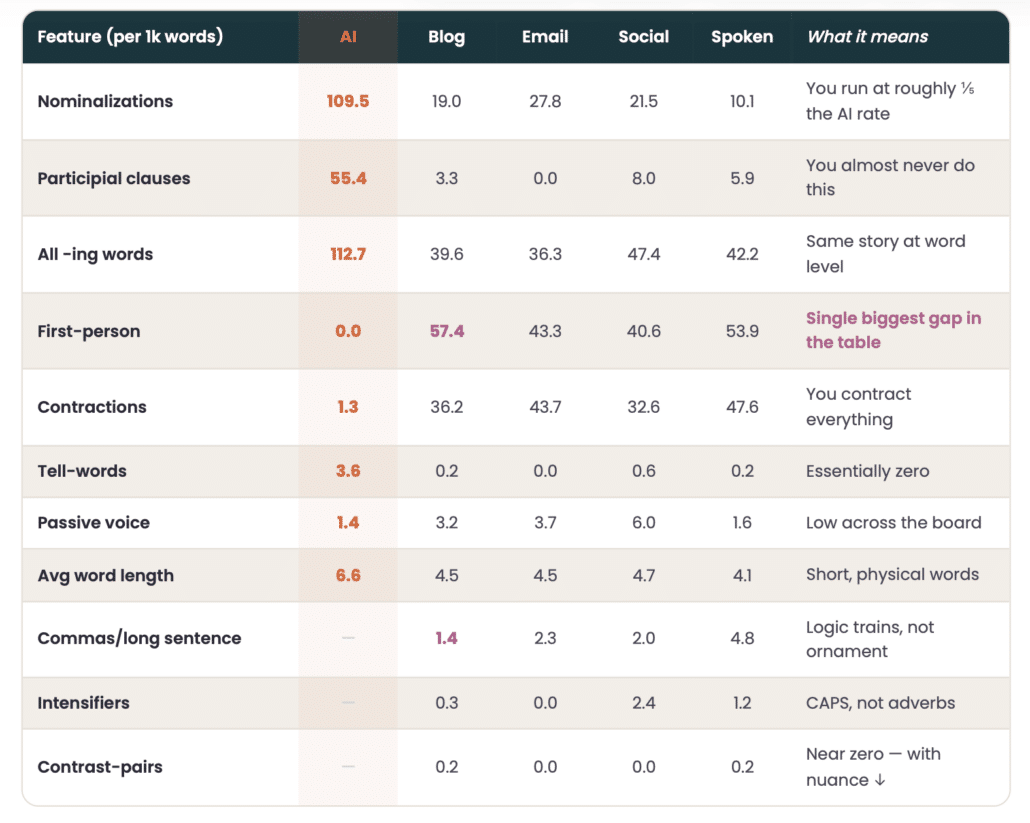
In other words, your voice is more than just a list of adjectives, it’s a set of communication behaviors (behaviors you’re probably not even aware of) and those moves are completely unique to you.
And defining your own brand voice by describing it in human generalities rather than specifics is…
Why AI Keeps Flattening Your Personality
Language models write by predicting the most probable next word which is a fancy way of saying they pull toward the “average” of everything it’s trained on.
But your personality is what makes you not-average, and the frustration we all feel is that the “averaging engine” keeps sanding that off and making us all sound the same.
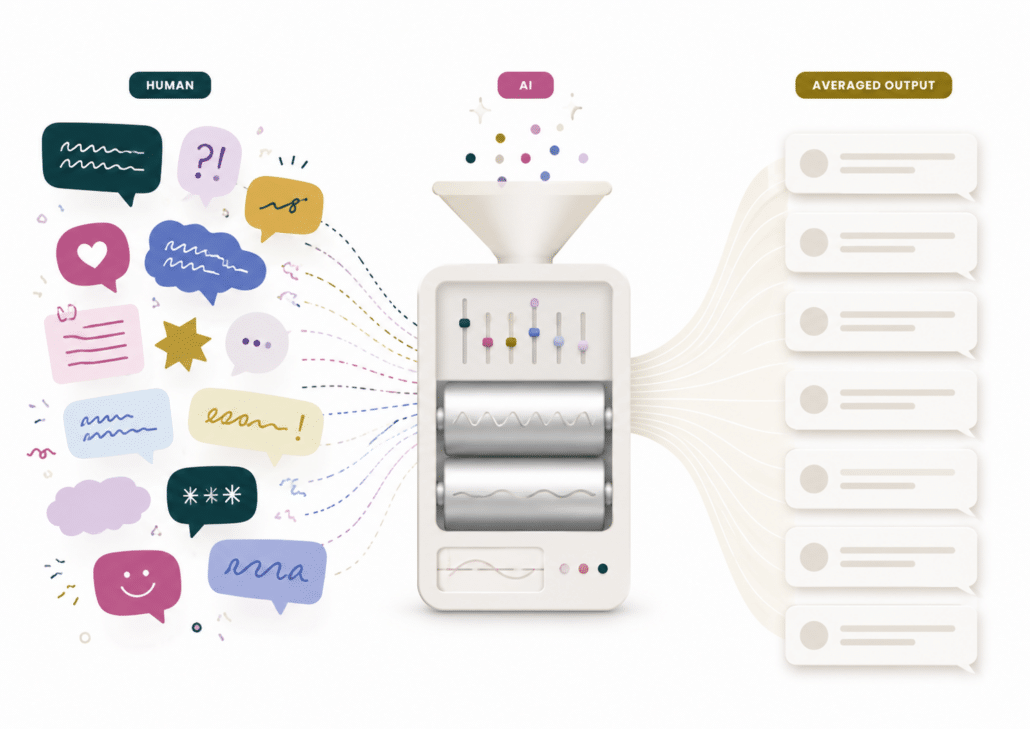
Another reason is instruction tuning. A 2025 study on the homogenizing effect of large language models found that this was one of the main mechanisms that squeezes the human out of AI writing.
After a model learns to write, AI companies pay human raters to score its output on helpfulness and safety, then train it to produce more of whatever the raters preferred. Those raters preferred polite, agreeable, inoffensive answers, so that’s what the model learned to produce.
In other words, sanitizing the output is a business decision. No company wants their model producing something that creates a PR disaster. The result is polite, agreeable, and inoffensive to everyone.
This all reminded me of a blogger I used to follow years ago, who built her entire personal brand around using the F-word. A lot. Headlines, product names, emails… the F-bomb was everywhere.
Don’t get me wrong, I enjoy well-executed swears in my personal time, but in a business context, it was just not for me.
And that’s good. She wasn’t trying to appeal to me or to just anyone, she was sending a signal to her people.
The whole point of creating content to build your brand isn’t to show up sounding like everyone else’s brand, it’s to set yourself apart so your target customers know who to choose.
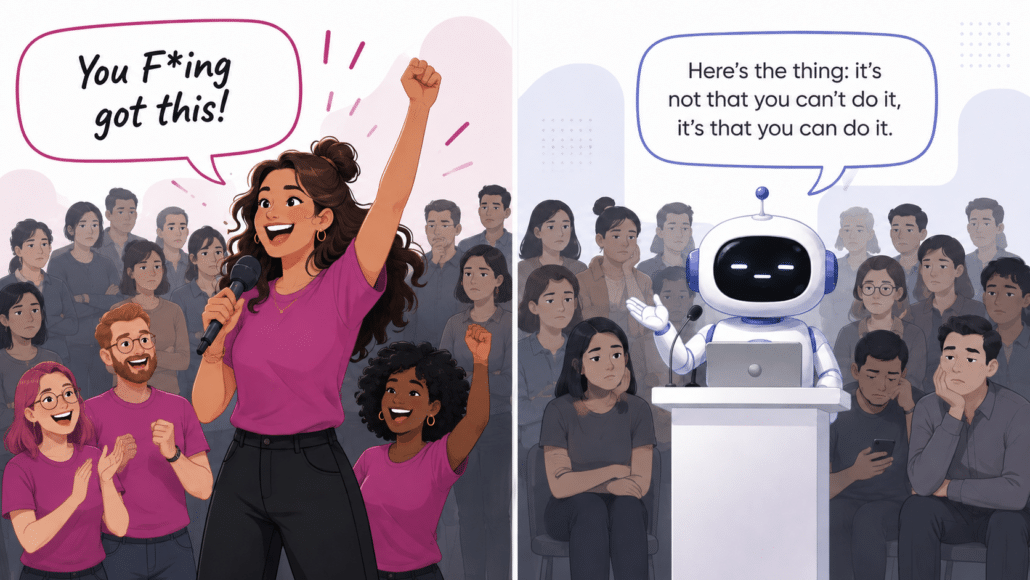
Given that, now let’s connect the dots on AI content: it tries to be “for everybody.” The problem is obvious. It’s why people are sick of AI slop, why it doesn’t move the needle on anyone’s business, and is potentially creating more problems for brands than it’s solving.
But let me be clear here: people don’t care if you use AI to help you, we’re all doing it. MIT did this great study called Human favoritism, not AI aversion where researchers found that it’s not about hating AI, it’s that humans prefer humans.
People want to see your human fingerprint on your content. And one of the biggest “tells” that a piece of writing came from a human is the underlying lack of uniformity.
Burstiness: Metronome vs Varying Rhythm
Large Language Models gravitate toward median sentence constructions that produce a “metronome” rhythm of sentences in a uniform range.
In contrast, human writing is “bursty” and irregular. We’re weirdos. We’re jazz.
We might argue a point in one big, long rambly sentence and maybe throw in some commas, some conjunctions, and we build it up real good and then boom. We land the verdict.
That sentence you just read? AI can’t do that by default. It needs to understand the patterns that exist in my natural writing and be handed those rules so it can follow them.
Burstiness is the way we naturally cluster ideas into a mix of extremely short, punchy sentences and long, elaborate ones.
There is no “burstiness prompt” I can share with you because my math is different from your math. My jazz is different from your jazz.
But this “burstiness gap” – the variation that exists in AI output (flat) and humans (varying) is something that humans pick up on when they read AI generated content.
They can’t always quite put their finger on why, but they can tell a human fingerprint is missing. Here’s what that gap looks like measured. I ran three of my recent blog posts through my Voice analyzer:
| Writer | Sentence swing (SD) |
|---|---|
| Generic AI (untrained) | 4.1 |
| Typical human writer | 8.2 |
| My blog posts (measured) | 13.3 |
The higher the SD, the wider the gap between the longest and shortest sentences. A 4.1 score is basically metronome—the AI is producing a one-note hum. The average human is twice that. But remember, as individuals none of us are “average.” We’re jazz.
My SD score of 13.3 means I’m routinely doing things like following a 40-word train of thought with a 3-word verdict. Before I could instruct the AI how to “sound like me” I first needed to know that piece of the equation.
In other words, what does “sound like me” actually mean? I just know it when I hear it because it’s my rhythm.
Now, let me tell you what it feels like to have the AI generate a draft that follows that natural rhythm pattern:
- I’m not annoyed because I’m reading AI-slop and trying to remove all the obvious tells (busy work, hate it)
- It’s more pleasant for me to read and edit because it aligns with how I think and phrase things
- Rather than “unbottifying” the draft, I’m just adding even more Taughnee too it
And because this changes the quality of the experience of something I do nearly every day in my work, the Voice Engine skill is something I never forget to reach for. It isn’t some prompt that I have to go hunt down in Notion when I think of it.
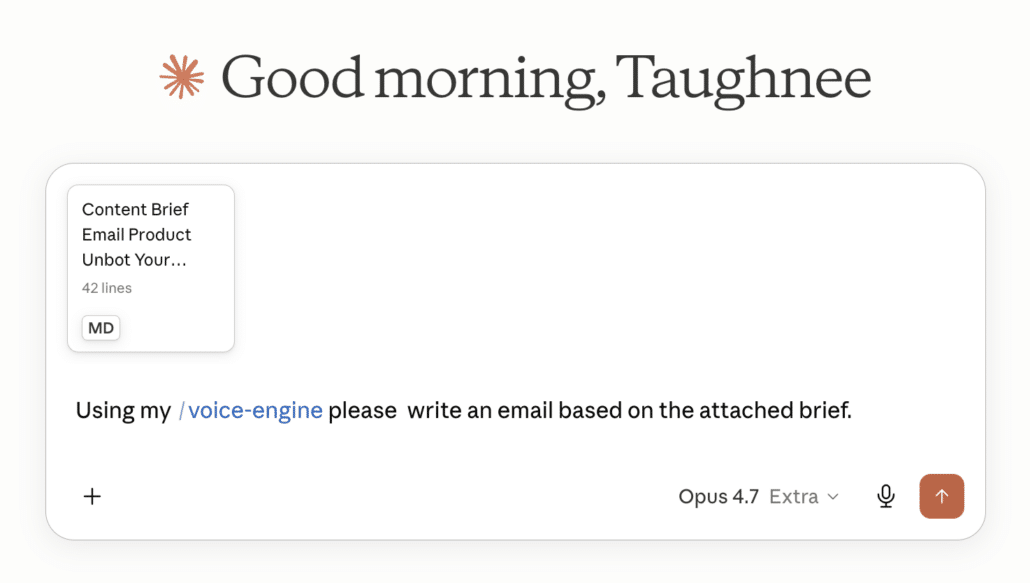
By setting it up as a skill in Claude, I just type “/voice-engine” to kick off every content creation session with it.
Perplexity: Predictable vs. Surprising Word Choices
Perplexity is another thing AI can’t do that humans do very well. This measures how surprising your word choices are, and it will not shock you that AI defaults to the least surprising option available in every single sentence.
The safe next word is the whole business model of a language model.
That’s why every untrained draft reaches for the same tired connectors, the same hedged claims, and the same three-item lists.
Human writers spike….
We drop a concrete, physical image where the machine would put an abstraction, we pick the blunt word over the polished one, and those small surprises are a huge part of what reads as “alive.”
Here are some examples from my blog post archives:
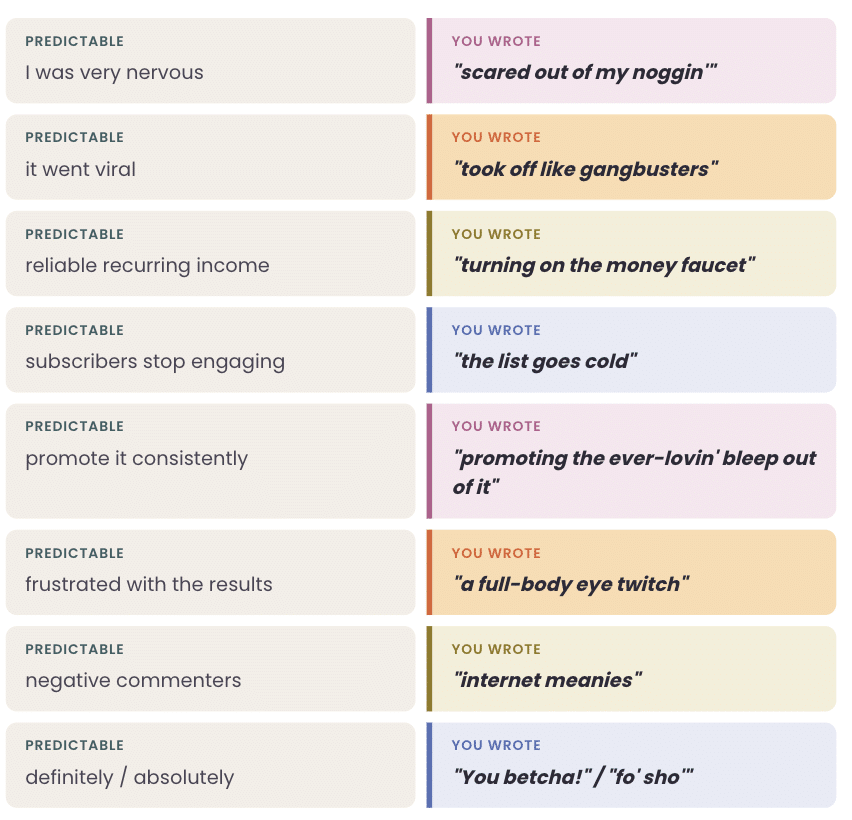
None of these are random. They’re a specific pattern: physical, folksy, body-felt.
And I didn’t even realize I had a pattern. Yours would look completely different, and that’s the point.
Put burstiness and perplexity together and you get a simple picture of what a reader is actually picking up on:
| Low Burstiness (flat rhythm) | High Burstiness (varied rhythm) | |
|---|---|---|
| Low Perplexity (safe words) | Likely AI | Rare |
| High Perplexity (surprising words) | Rare | Likely Human |
Low Perplexity + Low Burstiness = Likely AI. The words are highly predictable, and the sentence lengths are completely uniform.
High Perplexity + High Burstiness = Likely Human. The vocabulary is creative and unpredictable, and the sentence lengths vary wildly.
The Math Underneath Your Voice
To actually train an AI to understand your voice, it needs rules with numbers attached: rhythm targets the machine can hit or miss, budgets it can spend, and bans it can obey without interpretation.
That looks like:
- Your average sentence length and how far your sentences swing from it
- Which argument moves you reach for and how often you repeat them
- How likely are you to use participle clauses, contractions, nominalization and so on
None of this requires a data science degree, it requires a proper analysis of your real writing and speaking patterns quantifying the right criteria. Only from there can the “sounds like you” rules be created and obeyed by the AI.
The System I Built To Unbot Your Content
When I started off on my “how do you really make AI sound more like you” quest, I was skeptical it was even possible. After all, most of the people making such claims are doing it in sales copy that screams “Yeah, but obviously Claude wrote this, I can still tell.”
I just kept pulling the strings on the research and ran dozens and dozens of tests. After many, many, many failed attempts, I think I cried a little when Claude generated a blog post draft that captured my rhythm and texture. It sounded so completely different than any other draft I’ve created with AI, like a blog post I might have written 10 years ago before AI was even on our radar.
And it’s not just vibes, I had a way to measure it. I could see if it actually worked by looking at the numbers in black and white.
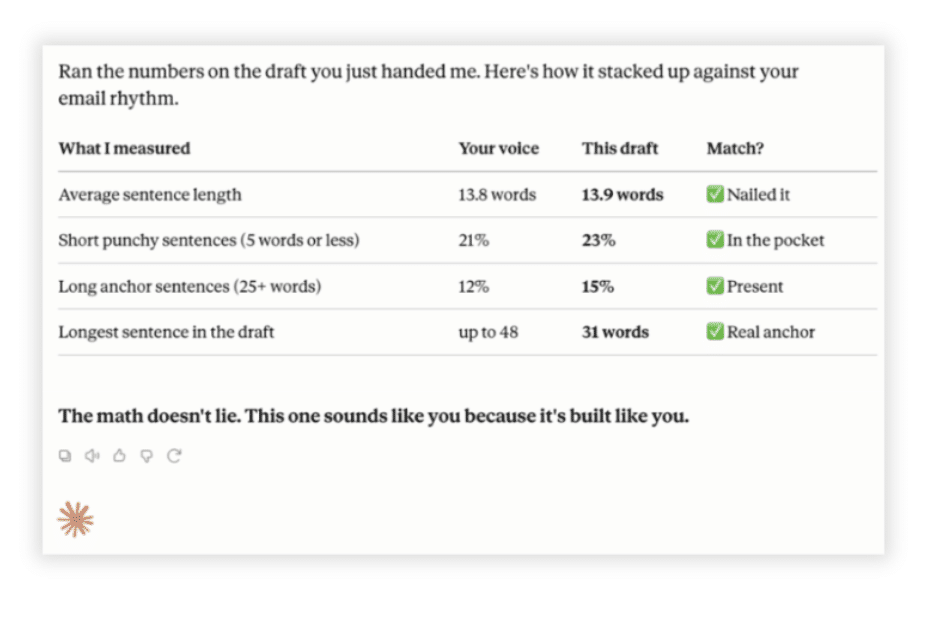
Mind you, it doesn’t get you to 100% human, or strip away every AI tell, or magically understand everything about you and what’s inside your head and exactly how you’d say things. That’s not possible and it would be terrifying it were.
But what it can do is get you pretty darn close to “holy bleep, that actually does sound so much more like me.” And for me personally, that completely changes my experience when using AI in my process.
I know I’m not alone in wanting (NEEDING!) something like this, so of course we’re sharing it. 🙂
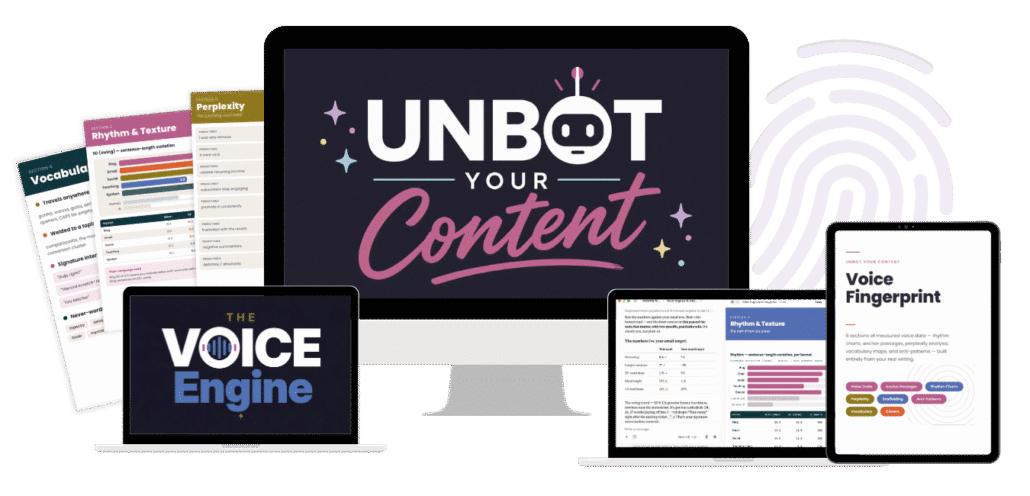
Unbot Your Content has all the tools and tutorials you need to set up your own Voice Engine to use in your AI workflow. First we’ll do an analysis of your unique voice fingerprint (you can look at mine here to see an example). Then, we’ll create your personalized rules for AI (the Voice Engine skill).
There’s more cool stuff included, natch. You can learn more about Unbot Your Content here.


Really enjoyed this perspective. Brand voice is more than tone or word choice—it's the unique experiences and opinions behind the content. AI can reflect a brand, but it still needs authentic human input to sound truly distinctive.