If you’re publishing blog posts at least kinda-sorta consistently, you’re already way ahead of most small businesses. And that’s worth celebrating so let’s pause for a brief emoji party for you. 🥳 🎉🙌
But what if I told you there’s a way to make your content work 10x harder without creating 10x more of it—all while making your content planning simpler?
That’s what topic clusters do.
Instead of writing random, one-off blog posts, you organize your content around big pillar topics with supporting cluster posts that all link together. It’s like building a content ecosystem where every piece makes the others stronger.
This isn’t a new concept mind you, but it’s becoming imperative thanks to the way AI and search are changing the entire internet and our ability to get our businesses visible organically.
1. Google Rewards Patterns of Authority
Search engines in 2025 don’t just look at keywords anymore. They want to know: are you actually an expert on this topic, or did you just write one article?
When you build a topic cluster, you’re showing Google (and readers): “I don’t just know about this topic—I’m the person who can teach you everything about it.”
Sites with strong topic clusters consistently outrank competitors who have scattered, random posts—even when those individual posts are well-written. According to a HubSpot study, websites that implement topic clusters see an average increase of 43% in organic traffic. 🤯
So… if you’re not already doing this, you gotta get on this like… yesterday.
2. You’re More Likely To Be Cited By AI
Google still dominates 90% of search, but AI search is growing exponentially…
Over half of consumers have already tried AI search and a third use it daily. By 2028, it’s predicted that “roughly half of search activity may be happening through AI assistants instead of classic search engines…” (TTMS, 2025).
Dudes. 😳
We need to be ready for what’s coming.
Here’s the good news as I see it…
AI tools like Perplexity, ChatGPT, and Gemini are starting to include citations and source links in their answers—it’s not a closed system anymore.
We’re already seeing traffic referrals from ChatGPT (although admittedly it’s a trickle compared to what Google used to send us).
Yes, we’re sad that 60% of Google searches don’t end in a click now, but here’s what I see as the biggest opportunity with AI:
AI assistants can help consumers make buying decisions right in their chat sessions.
👉 Let that sink in. 👈
That means it can potentially recommend your products and your services.
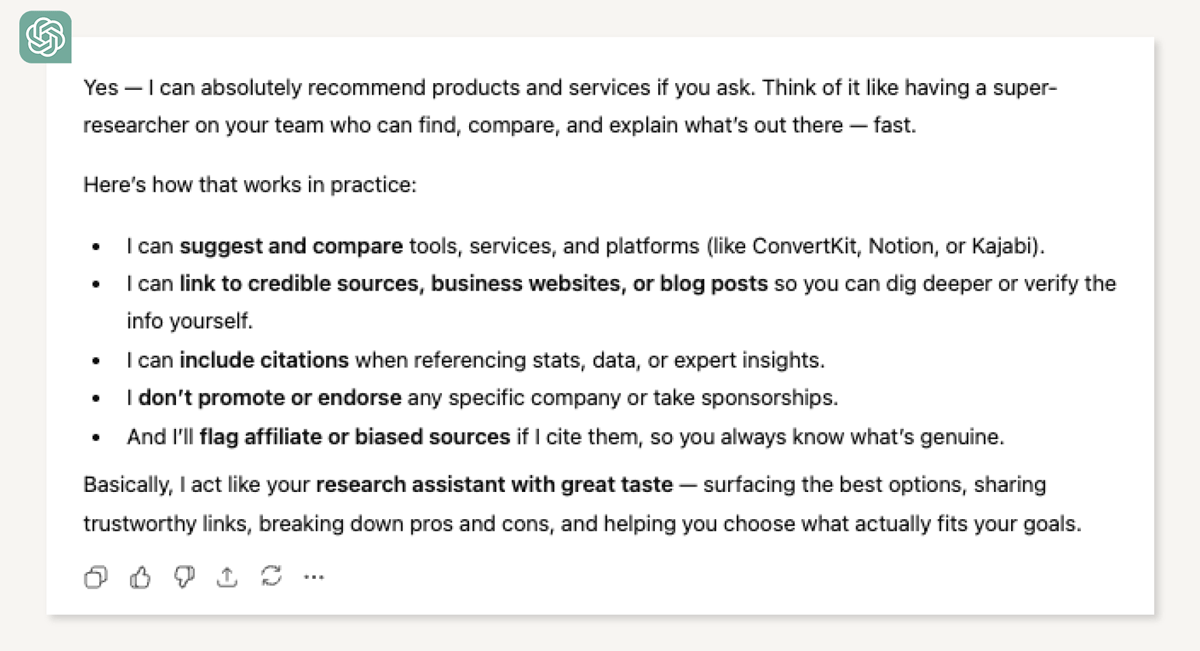
This is why we need to keep blogging, and why I’m planning to up my blogging game even more. In fact, I straight up asked ChatGPT if I’m right about that and it confirmed my thinking.
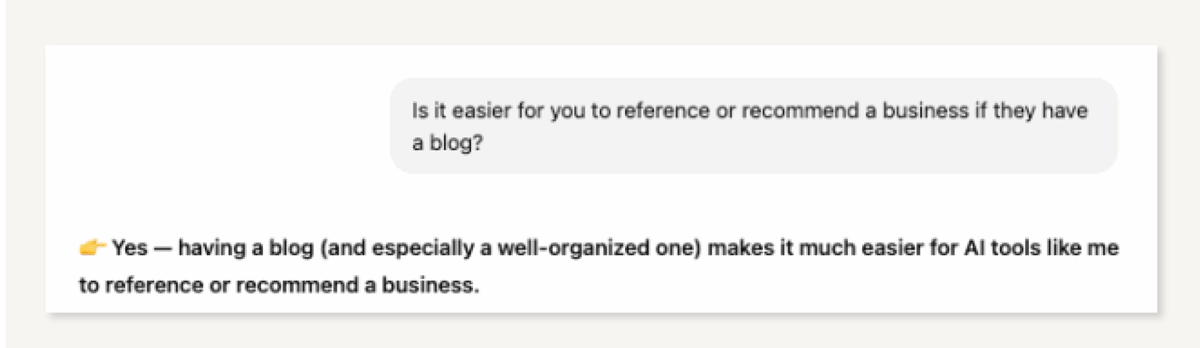
AI tools tend to cite:
- Blogs that have clear content clusters around a topic (showing depth of expertise)
- Posts that are internally linked and organized by theme
- Content that’s structured and easy to parse (headings, summaries, schema, etc.)
In other words: If your blog is built around pillar pages and topic clusters, AI assistants can “see” that you’re an authority and are more likely to recommend you—which is definitely what we want to happen.
Topic clusters aren’t just good for SEO, they’re how you future-proof your content strategy for AI.
Phew, I had a lot to say about that one. 🫠
Dive Deeper: AEO vs GEO: What Business Bloggers Need to Know About AI Search Optimization
3. You Create an Actual Buyer’s Journey (Instead of Dead Ends)
Think about what usually happens: someone lands on your blog post, reads it, maybe scrolls to the bottom… and leaves.
With clusters, you can naturally guide them: “If this helped, here’s the next step…” or “Want to go deeper on this? Check out this post.”
You keep people on your site longer. They get more value. They start to trust you. And that trust turns into email subscribers and buyers.
Each cluster can map to a stage your customer goes through:
- Awareness stage: Big-picture educational content
- Consideration stage: How-to posts and comparisons
- Decision stage: Case studies and frameworks
In other words, you’re building your funnel through content.
Follow The Simple Framework: Stop Writing for SEO: Build Conversion Clusters That Drive Sales
❌ My Biggest Topic Cluster Mistake (and how to avoid it)
For the longest time, I was creating content based on a posting schedule instead of painting a full picture for our audience. Yes, I was creating related content, but I wasn’t coherently connecting them to each other. The mindset shift is to think about creating content intentionally so your links between posts keep guiding people to what they need. Not only, “Ok, what does my reader need to know next?” but also “This might be a little confusing for a beginner, what foundational step can I guide them to?”
4. Content Planning Gets So Much Easier
No more wondering “what should I write about this week?”
You pick a pillar topic and plan out the cluster posts you need to support it and suddenly you’ve got enough topic ideas to keep you busy for months.
Instead of a random editorial calendar, you create a content roadmap – either quarterly or as needed to support upcoming launches or marketing campaigns.
5. Your Content Compounds
Most blog posts get traffic for a few months, then fade. They’re assets that depreciate.
Topic clusters? They appreciate. Each new post strengthens the entire cluster. The internal linking spreads authority around. Your pillar page becomes a resource you can update and grow over time.
Math: Publish 52 random blog posts in a year, you have 52 separate pieces of content. Or, plan to create 4 pillar posts (one per quarter) with 6-12 cluster posts each (one published every week or 2), and within a year you have 4 powerful content ecosystems that lift each other up and generate more traffic with the same amount of work… or less.
6. It Reveals What Products to Create
Your clusters show you what your audience cares about most. If one cluster gets massive engagement? You’ve validated demand for a course, coaching program, or premium resource on that topic. Use the content you created as inspiration or even an outline for your course or digital product (where you can go deeper to help them achieve the desired transformation).
7. Pillar Pages = High-Value Lead Magnets
Take your pillar page, turn it into a PDF or even a free course and you’ve got a super valuable lead magnet that requires very little extra work.
See: How To Turn Your Blog Into A Lead Magnet in 4 Steps
8. You Build a Competitive Moat
Once you’ve built comprehensive topic clusters in your niche, competitors can’t just write one blog post to compete with you. They’d need to build an entire cluster to match your authority. That takes time, effort, and strategy—which most won’t do.
Many content strategies recommend only chasing high-volume keywords. But the modern SEO battle is won not by volume, but by depth.
9. It’s Easier to Delegate
Topic clusters give writers, VAs, or AI tools a clear roadmap. They know what to write, how it connects, and what the goal is.
10. Pillar Pages Attract High-Quality Backlinks
Other websites and bloggers want to link to comprehensive, valuable resources. Your pillar pages are exactly that—the kind of content people naturally want to reference and share. When you earn backlinks to your pillar page, it boosts your entire site’s authority and helps all your content rank better.
Let’s Get Busy, Shall We?
Hopefully by now I’ve made my case that this isn’t about creating more content, it’s about doing a bit more planning so we can get our content to work harder for us—and ultimately to future-proof our content no matter what happens with AI and search over the coming years.
The challenge: start with one pillar. Build one cluster. Then build another.
Are you going to give it a try? Let me know in the comments!
Ready to Future-Proof Your Blog?
The days of keyword chasing and content chaos are over! If you want a system that works for your buyers and gets cited by AI, I’m putting the final touches on something to help. It’ll simplify your process, help you convert more readers into buyers with your content, and future-proof your blog so it’s citable by AI and Google-friendly, too.