
We all start blogging with the best of intentions… We’re gonna publish a post every week, build our email list, and get our business visible with potential customers without paying for ads. 💪
But then, somehow it doesn’t go quite according to plan…
We sit down to write, spend 30 minutes trying to come up with a topic, another hour checking out the competition, another three hours typing and trying to organize our thoughts into something coherent…
And by the time our work session is finished, we’re already exhausted and our blog post stays stuck in draft.
Pretty soon, blogging becomes a chore we’d rather avoid instead of the enjoyable process we imagined.
Well here’s what I know after doing this for 20+ years: consistency isn’t about willpower, it’s about systems.
The bloggers who show up consistently aren’t more disciplined than the rest of us. They’ve just built workflows that eliminate the friction, decision fatigue, and mental overwhelm that makes blogging feel hard.
Along the way, I’ve picked up a few habits that have made the process so much easier. To this day, I always look forward to blogging because it’s predictable and repeatable – not something that goes completely off the rails anymore.
So if you’re struggling to stay consistent or just want to make blogging feel easier, take a look and give one or more of them a try.
And by the way, all of these things are backed by science, so in this post I’m going to share what’s actually creating the friction and how to build systems that work for you.
Ready? Let’s go. 😎👇
- Habit #1: Stop waiting to “find time” or for “motivation to strike”
- Habit #2: Separate topic research tasks from writing tasks
- Habit #3: Determine the focus of your post before you write a word
- Habit #4: Outline your posts so you can write in chunks
- Habit #5: Use AI to generate draft copy section by section
- Habit #6: Batch multiple blog post drafts in one focused session
- Habit #7: Create rituals that signal “it’s time to focus.”
Habit #1: Stop waiting to “find time” or for “motivation to strike”
Let’s get this out of the way right up front: waiting for a perfect block of time to write an entire blog post from start to finish is setting yourself up for defeat.
We imagine that bloggers clear an entire afternoon and then sit down to brainstorm a topic, outline it, write it, edit it, find images, and schedule it—all in one session. But that’s rarely the reality.
Life happens.
You get distracted.
The free afternoon never comes.
Or it does, but you’re so overwhelmed by everything you need to do that you freeze up and accomplish nothing.
The science
This is called task complexity paralysis. When your brain sees a task as too big or multi-faceted, it actually resists starting. Research on motivation shows that breaking large tasks into smaller, discrete steps makes them feel more achievable, and you’re way more likely to actually do them.
Make it 10x easier
Never sit down to “write a blog post.” Sit down to work on ONE part of the process.
For example, today I might just be researching topic ideas. Tomorrow I might check out the competition in search and flesh out a rough outline. The next day, I’ll put my rough ideas under each section and so on.
That way, you can make progress whether you have 15 minutes to chip away at some part of the process or find yourself in the zone and decide to spend 3 hours in deep work.
Habit #2: Separate topic research tasks from writing tasks
When you sit down with the intention to write without already knowing the topic, what you’re actually doing is sitting down to find a topic, because that always comes first.
You might look for ideas by checking out what your competitors are posting, browse around Pinterest, scroll through Instagram, do topic research using SEO tools or ChatGPT and then spend some time thinking about which will be the best fit for your audience.
The point is that doing topic research when the task on your to-do list is to write a blog post sets you up to feel overwhelmed before you even dive in.
The science
This is called task switching. Your brain doesn’t like flipping between two totally different types of thinking like idea generation and focused writing. Every time you switch, your brain has to reset. Which means it takes more time, drains more energy, and makes it harder to focus.
Make it 10x easier
Separate topic research and idea generation from the writing process entirely. They’re two different tasks that require two different types of thinking and trying to do them at the same time is what creates mental friction.
Try setting aside one focused session to build up a topic idea bank until you have so many ideas, it’ll keep you busy for weeks or months.
Grab our Topic Prompts & Planner below for templates you can use.
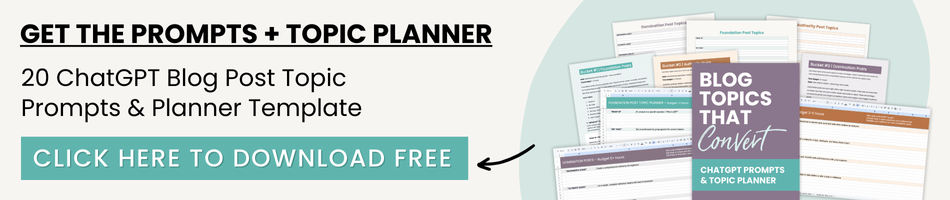
Now when it’s time to work on a post, you’ll pull from your bank of topic ideas. No task switching. Your writing sessions become 10× less stressful.
Habit #3: Determine the focus of your post before you write a word
You can’t just open a blank page and start writing whatever comes to mind.
I mean, you can—but you’ll end up with a meandering mess that frustrates you and confuses your reader. You’ll write for hours, delete half of it, add more, rearrange sections, and still feel like it needs more fine-tuning before you hit publish.
This happens when you skip defining the focus for the post first.
The science
This is cognitive load theory. When you’re trying to simultaneously figure out WHAT to say, HOW to organize it, and WHERE each piece fits, you overload your working memory.
But when you start with a clear focus before you dive in? You have a container for your ideas and won’t be paralyzed by infinite possibilities. You know where you’re taking people and what needs to be included and where.
Make it 10x easier
Before you write a single word, ask yourself:
👉 What is the ONE thing I want the reader to know or do after reading this post?
👉 What’s the main takeaway?
👉 What is the promise your blog post title is making?
That’s the focus.
Not three other things.
Not “I feel like writing about X too today.”
Not “I’m in the mood to share everything I know about Y while I’m at it.”
Just one focused goal.
👉 Once you decide your focus, then everything that doesn’t directly support that doesn’t belong in this blog post.
Remember that readers clicked on your post in the first place because the title made a promise. Now it’s simply your job to deliver on it so they can get what they came for as efficiently as possible.
Think of each h2 subheading as something they can skim immediately after landing on your post and get right to the part they came for.
If you’re tempted to go on tangents (this happens to me every single time), ask yourself if it would make more sense to create a separate post.
I’m constantly catching myself: “Are you going down a rabbit hole here, Taughnee? Is this what they came for?”
If so, I delete that section and stick it in a new document to flesh out as its own post later. Then, I come back to the original post and provide a “to learn more, read this other post” link.
The cool thing is, there are bonus benefits if you get into the habit of doing this!
→ Internal linking of related topics sends a strong signal to Google
→ It creates a bingeworthy experience for your audience
→ It gives you a starting point for your next blog post
Personally, I think a lot of the frustration we feel when blogging happens when we start trying to cram 2-3 blog posts into 1 blog post.
But to be clear…
❌ I don’t mean that you can’t write long posts.
❌ I don’t mean that you can’t include multiple subtopics that relate to the larger topic.
✅ I’m saying to get clear about the focus first so you can avoid going on tangents.
The more focused you can be, the more engaging it will be for your audience and the less stressful the writing process will be for you.
You don’t need to say everything or cram it all into one post. Just deliver one clear outcome and cut anything that doesn’t support it.
Habit #4: Outline your posts so you can write in chunks
The hardest way to write a blog post is to start at the top and try to write your way to the bottom, figuring out what to include as you go.
Even if you get into a state of flow and your ideas are pouring out of you, you’re usually left with a ton of refinements to make…
Where does this go?
Is this even relevant?
Should I add something here?
Should I take this part out?
Should I move this up to the top?
Instead of being done by now, you’re stuck making structural decisions and trying to organize your post into something that makes logical sense.
But that’s backwards, and a recipe for frustration.
The science
This is cognitive load theory. When you’re writing, organizing your ideas, and editing at the same time, you overload that system. That’s why even a productive writing session can leave you feeling drained, because the mental effort of sorting, structuring, and refining on the fly adds an extra layer of stress.
Make it 10x easier
Once you know the focus of your post, the next step is to create your outline starting with your main H2 subheadings.
What sub topics do you need to include to fulfill the promise of your blog post?
For example, if I’m writing “7 Habits That Make Blogging 10x Easier,” my H2s include:
Habit #1: Stop waiting to find time
Habit #2: Build a topic bank
Habit #3: Determine the focus first
And so on…
Creating your outline first is like making an executive decision about the scope of your project before you start working on it. Rather than trying to organize your post after you’ve written it, you just follow your plan and save yourself a ton of time and mental effort.
H2s subheadings represent clear subtopics, which means you can treat each one like a mini blog post inside the larger one, making it easier to start and easier to finish.
In other words… if you have five H2s with a goal to write 300 words under each one? That’s not one big scary blog post, it’s five mini blog posts. And writing 300 words is not as intimidating as writing an entire post in one sitting.
So, if “I never have the time to work on my blog” is something you believe, it’s not true.
You don’t need a three-hour block of “perfect focus time,” you just need a better process. One where you can work on one step at a time and always know where you left off and where to pick up the next time.
The #1 thing our Blog Post Vault customers tell us is that it isn’t coming up with ideas that they struggle with, they have boatloads of them. It’s not having a process for organizing the ones they’ve got that slows them down. Having pre-structured templates to follow doesn’t replace their creativity, it just eliminates the decisions that create mental fatigue.
Set yourself up so these kinds of decisions are made before you write. It makes it 10x easier to get into a state of flow – and that’s the part that makes blogging fun and rewarding.
Habit #5: Use AI to generate draft copy section by section
Let’s talk about AI.
I know some people are scared of it. They worry it’ll make their writing sound robotic or generic. And honestly? If you just copy-paste-publish what ChatGPT spits out, you’re right – it will definitely sound generic.
So remember…
👉 AI isn’t a replacement for your writing. It’s a tool that can help you in your writing process.
It reminds me of something Hemingway once said: “The only kind of writing is rewriting.”
He would draft novels, put them away, and return to them much later so he could judge them objectively and completely re-work them. Only this time, not from a blank page.
And that’s how you should think about using Ai to help with your writing tasks – as a tool to help you get words on a page that you can use as a starting point.
Then, be like Hemingway (no pressure 😉) and re-work it.
The science
Starting from scratch activates the part of your brain that’s terrible at getting started (thanks, perfectionism). But editing something that already exists? Way easier. Your brain loves fixing things more than creating them from nothing.
Make it 10x easier
Use AI to generate draft copy but instead of just saying “write a blog post on X topic” – use the outline you created (see Habit #4) and ask it to generate a short post for each H2 section.
You can give it a target word count (e.g., 500 words) and any key points you want to be sure to cover in that section. That way, what AI comes up with will be a bit more substantial than what it can do if it’s instructed to write a whole post.
The Blog Post Vault is a tool that can help with this workflow tremendously. I often start with one of the templates because each section is pre-written with writing prompts that ChatGPT interprets as instructions. I just copy and paste each section one at a time and within a few minutes I have a first draft with a ton of material to work with.

Then I put it aside to rewrite in another session.
In fact, that’s what I did with this blog post. I’m rewriting it right now. I’ll be setting this up to publish in a couple of hours, so I’m in the last stretch.
Virtually nothing here remains from either the template I started with or the AI copy I generated. I’m just fully in a state of creative flow and following the structure I set up for myself.
The truth is, MOST of the time I spend creating blog posts is rewriting. It was that way before I started using templates or Ai and it’s true today.
And it’s the same process traditional writers have used forever: write the first draft fast and ugly, then polish it later.
Using blog post templates and/or AI just speeds up step one.
Habit #6: Batch multiple blog post drafts in one focused session
Remember how we separated topic generation from writing in Habit #2? That’s batching—grouping similar tasks together so your brain can stay in one lane. You can also batch complete first drafts.
Full disclosure: I don’t always do this. But when I do, I feel so much more ahead of the game. In one focused work session, I might take 3-5 topics from my topic bank and turn them into complete draft outlines (as covered in Habit #5).
I don’t edit it. I don’t polish it. I just generate the raw material and store it.
Now I have a draft bank ready for me to rewrite whenever I have time.
The science
Context switching—jumping between different types of tasks—costs you an average of 23 minutes of focus every single time. Research shows it takes that long for your brain to fully re-engage after an interruption or task switch.
When you’re constantly switching between “creation mode” (generating ideas, outlining, drafting) and “editing mode” (refining, polishing, rewriting), your brain is always playing catch-up.
But when you batch all the generative work into one session? You stay in creation mode. Your brain gets into a rhythm. Later, when you come back to rewrite, you’re fully in editorial mode. You’re not creating from nothing; you’re shaping what already exists.
Make it 10x easier
The next time you create a first draft using template or AI (or both), try extending your work session to get 3-5 more first drafts in the can while you’re there.
Then, in a completely separate work session, pull from your bank of drafts and spend more time focused on the unique value only you can bring to the post:
- Adding your stories and personal experiences
- Injecting your voice and personality
- Cutting the fluff
- Strengthening the examples
- Making it YOURS
And if you’re like me? Aim to leave it just a little bit imperfect. Don’t overfuss. We’re all tired of the “perfect writing” Ai generates, aren’t we? It’s a pleasant surprise when an imperfect human shows up.
Habit #7: Create rituals that signal “it’s time to focus.”
Here’s a tiny habit that’s had an outsized impact on my consistency: I create rituals that signal to my brain it’s time to write.
For me, that’s putting on focus audio—binaural beats, frequency music, Brain.fm, Moongate. It doesn’t have to be the exact same song every time. But the act of putting on my headphones and pressing play on that kind of audio? That’s the signal. My brain knows: focused work time starts now.
After doing this consistently for years, I don’t have to “find motivation” anymore. The ritual does the heavy lifting.
The science
This is called “implementation intentions” or cue-based habits, and it’s one of the most well-researched concepts in behavioral psychology. James Clear talks about it extensively in Atomic Habits: when you pair a behavior with a consistent cue (a sound, an action, a ritual), you remove the need for willpower.
Your brain starts to associate that cue with the behavior. Eventually, the cue itself triggers the action—you don’t have to consciously decide to start. You just do.
Your rituals might look different than mine—and that’s… ok!
Make it 10x easier
Here are some examples:
- Clean your desk before you write: Once it’s clear, that’s your signal to start
- Close all browser tabs except the doc you’re working on: Digital decluttering as a focus cue
- Fill your water bottle and set it next to you: One less reason to get up mid-flow
- Use a Pomodoro timer: The act of starting the timer becomes your “go” signal
- Put on headphones (even with no music): Physical barrier that says “I’m working now”
- Open a specific app or tool: Forest, Focus@Will, Freedom—whatever works for you
The key is consistency. Pick one or two rituals and do them every time you sit down to work on your blog. Your brain will learn the pattern, and starting will get easier.
Pro tip: If you’re working on different tasks (topic research vs. drafting vs. editing), consider using different rituals for each. Maybe focus audio for drafting, but instrumental music for editing. This trains your brain to shift into the right mode faster.
You made it! 🎉
If you’re still here, it means you’re serious about this. You’re not looking for another “just be more disciplined” pep talk—you want real systems that actually work.
Remember…
Consistency doesn’t happen by accident. It happens by design.
You don’t need more willpower. You don’t need to work harder. You just need habits that eliminate the friction, remove the decision fatigue, and make showing up feel easy.
So here’s my challenge: pick ONE habit from this list and implement it this week. Just one.
- Will you break your blogging process into smaller tasks?
- Will you build a topic bank so you’re never scrambling for ideas?
- Will you start defining focus before you write?
- Will you outline your posts so you can write in chunks?
- Will you use AI section by section to generate draft copy?
- Will you batch your drafts so you always have something to rewrite?
- Will you create environmental cues that make starting easier?
And if you want a head start? Be sure to grab the Topic Prompt and Planner before you go. 👇
Now go build your system. You’ve got this. 💪
Which habit are you going to try first? Let me know in the comments!

